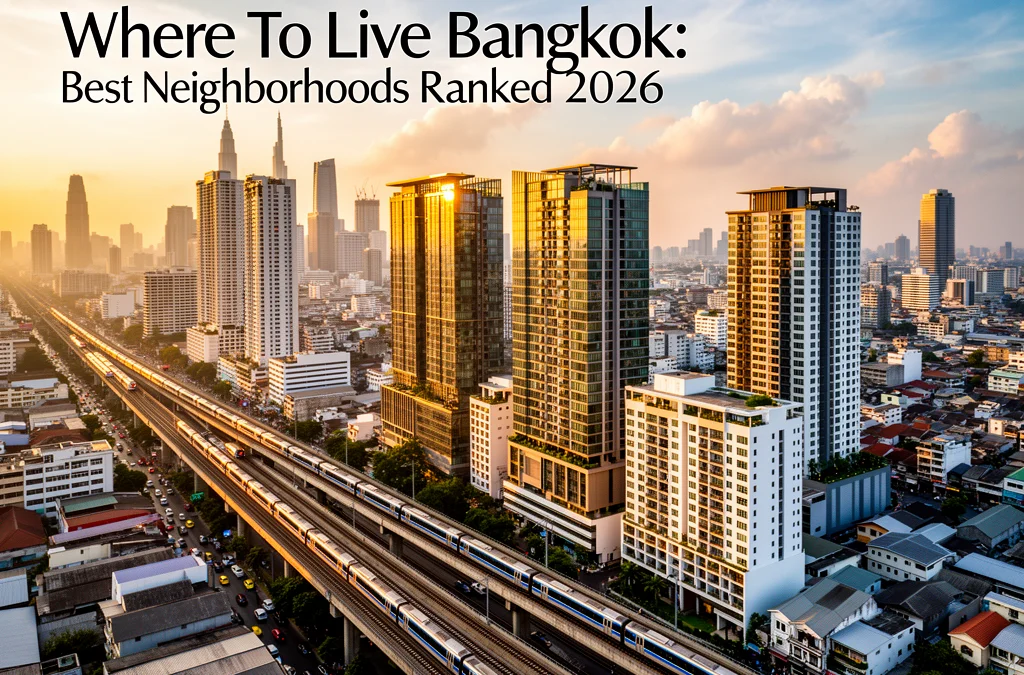
TL;DR: Deciding where to live in Bangkok depends on your budget, commute needs, and lifestyle. Central Sukhumvit (Asok to Thong Lor) offers maximum convenience at 30,000–75,000 THB/month for a 1BR. Budget-conscious expats should look at On Nut or Rama 9 (12,000–30,000 THB). Families gravitate toward Sathorn for international schools. New MRT lines opening through 2028 will make emerging areas like Rama 9 and eastern Thonburi significantly more connected.
Why Your Neighborhood Choice Matters More Than You Think
When I worked as an urban planner at the Bangkok Metropolitan Administration (BMA), I spent years studying how this city's neighborhoods function — the traffic patterns, the transit nodes, the zoning decisions that shaped where people could live and work. One thing became clear: in a metro area of 11.5 million people spread across 1,568 square kilometers, your neighborhood choice determines your quality of life far more than your apartment itself.
Bangkok's average commute time sits at roughly 46 minutes each way according to the BMA Travel Time Dashboard. That number masks enormous variation. Live near a BTS or MRT station and your commute might be 15 minutes. Live in a neighborhood that requires a daily taxi or motorcycle ride to reach transit, and you easily spend 90 minutes each way — adding over 200 hours per year to your commute compared to someone who chose wisely.
According to the Department of Rail Transport, Thailand's rail systems carried over 547 million passenger-trips in 2025, with Bangkok's BTS and MRT handling the lion's share. Getting the decision right when figuring out where to live in Bangkok means the difference between loving the city and resenting it.
Bangkok's Geography and Transit System — The Framework That Matters
Bangkok developed along two axes: the Chao Phraya River (north-south) and Sukhumvit Road (east). Modern transit follows these corridors. The BTS Skytrain runs above Sukhumvit Road and Silom, while the MRT Underground runs beneath Ratchadaphisek Road and connects through the center. The key insight: the closer you live to a station, the more of Bangkok opens up to you.
The BTS and MRT systems currently carry over 1.2 million passengers daily combined, according to Statista ridership data. With the Yellow Line (opened 2023), Pink Line (opened 2023), and the upcoming Orange Line (expected 2027–2028), Bangkok's rail network will nearly double in coverage over the next few years. This expansion is already reshaping property values in neighborhoods that were previously transit-poor.
Where To Live Bangkok: The Decision Flowchart
Before we get into the neighborhoods, here's a framework for narrowing your choice based on budget and lifestyle priorities:

Central Sukhumvit — The Expat Default
When people ask where to live in Bangkok, the first answer is almost always "Sukhumvit." The Sukhumvit corridor stretching from Nana to Ekkamai is home to the largest concentration of foreign residents in the city. Here is why: maximum BTS connectivity, dense restaurant and bar infrastructure, easy English-language navigation, and a large established expat community.
From my urban planning work, I can tell you that Sukhumvit's development wasn't accidental. The even-numbered sois (side streets) run south and tend to be quieter and more residential, while odd-numbered sois run north and tend to carry more commercial activity. This zoning pattern, established through BMA planning decisions in the 1980s and 1990s, means you can live two blocks from a BTS station on a quiet residential soi — if you know which soi to pick.
What most people get wrong: They assume all of Sukhumvit is the same. In reality, the character changes every 2–3 BTS stops. Asok is a commercial transit hub. Phrom Phong is a refined residential zone. Thong Lor is a nightlife destination. Ekkamai is a foodie enclave. Picking the wrong section of Sukhumvit can leave you paying premium prices for a lifestyle you did not want.
Asok — The Transit Crossroads
Asok (Sukhumvit Soi 21) is where the BTS Skytrain and MRT Underground intersect — the only direct interchange between the two systems. Terminal 21 mall sits at the junction. Soi Cowboy's nightlife runs parallel.
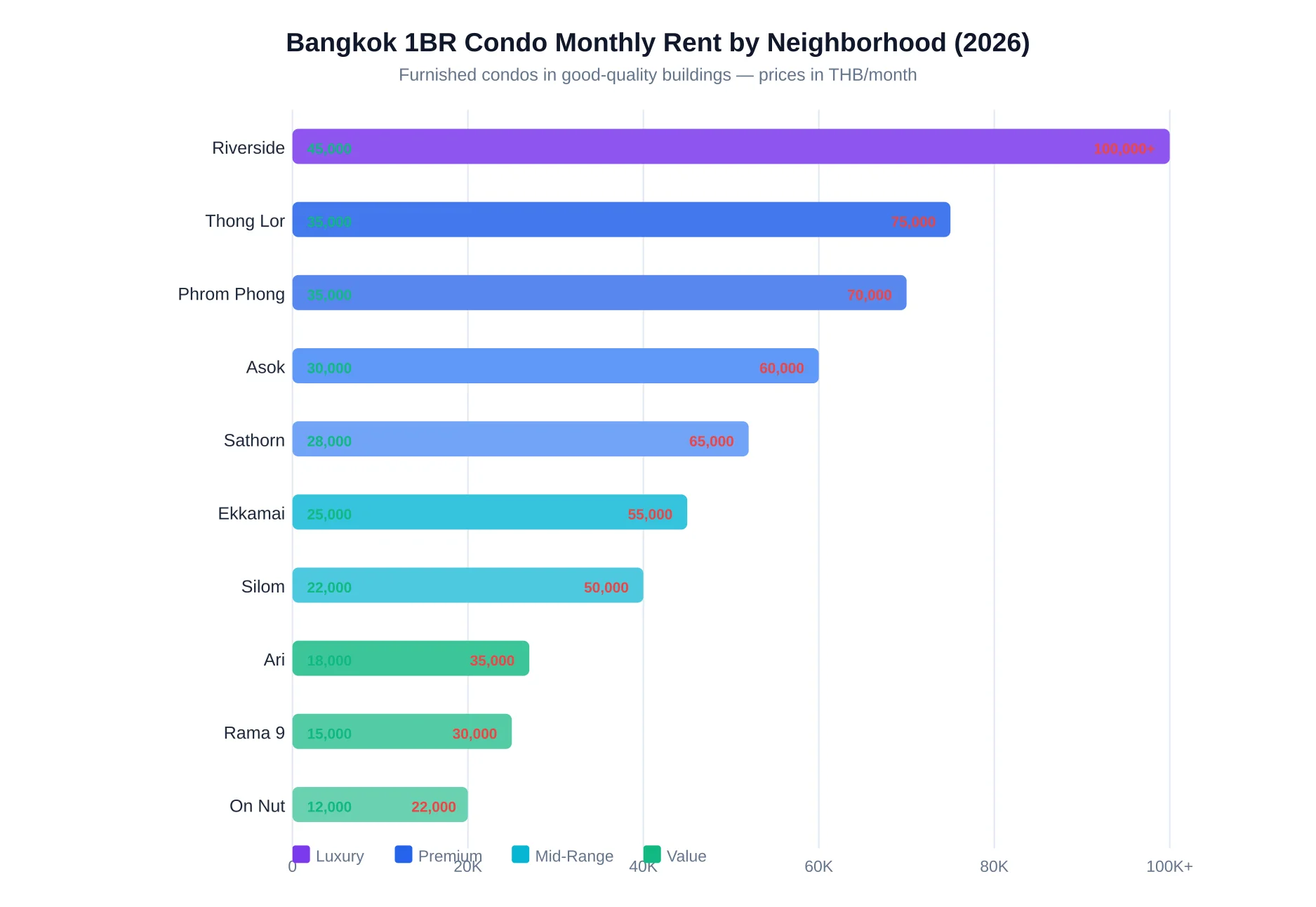
1BR rent: 30,000–60,000 THB/month
Best for: Working professionals who want zero commute friction and maximum city access
Trade-off: Busy, noisy, more expensive than anywhere else on the BTS line
Asok is the single most connected point in Bangkok. If your work takes you to multiple parts of the city, living here minimizes your total transit time. The downside: you pay a premium for that connectivity, and the atmosphere is more "commercial hub" than "residential neighborhood."
Phrom Phong — Japanese Precision and Premium Living
Phrom Phong (BTS Phrom Phong, Soi 24–39 area) is where wealthier expats and Japanese families cluster. The Emporium and EmQuartier malls anchor the area. The neighborhood is noticeably cleaner, quieter, and more polished than Asok.
1BR rent: 35,000–70,000 THB/month
Best for: Families, Japanese expats, professionals wanting a refined atmosphere
Trade-off: Higher price-to-space ratio; less nightlife than Thong Lor
Phrom Phong benefits from its proximity to NIST International School and Wells International School, making it a magnet for families with school-age children. Property values here have been among the most stable in Bangkok through market cycles, largely because the family demographic provides consistent demand.
Thong Lor — Bangkok's Nightlife and Dining Capital
Thong Lor (Soi 55) is the neighborhood people mean when they say "Bangkok is trendy." High-end cocktail bars, Michelin-worthy restaurants, Japanese izakayas, boutique fitness studios, and some of the city's most expensive condos.
1BR rent: 35,000–75,000 THB/month
Best for: Young professionals, socialites, food and nightlife enthusiasts
Trade-off: Expensive, noisy on main soi, less family-friendly
Thong Lor's property values have appreciated approximately 40–60% over the past decade, driven by its reputation as Bangkok's lifestyle destination. From a planning perspective, I've watched this neighborhood transform from a quiet residential area into a high-density entertainment and dining zone — a shift that has made some long-term residents uncomfortable but has made it one of the city's most sought-after addresses.
Ekkamai — The Smart Alternative to Thong Lor
Ekkamai (Soi 63) sits one BTS stop east of Thong Lor and offers much of the same dining and lifestyle appeal at a lower price point. The dining scene here is genuinely excellent without the premium markup.
1BR rent: 25,000–55,000 THB/month
Best for: Couples, food lovers, people priced out of Thong Lor
Trade-off: Slightly less walkable main soi, fewer premium condo options
Ekkamai is what I recommend to people who want Thong Lor's atmosphere but not Thong Lor's prices. The BTS ride to Thong Lor is 2 minutes. The savings on rent are 20–30%.
Sathorn and Silom — The Business District Alternative
When considering where to live in Bangkok for professional purposes, Sathorn and Silom deserve serious attention. These are Bangkok's primary business districts — home to corporate headquarters, embassies, and financial institutions.
Sathorn — Embassy Row and Family-Friendly Living
Sathorn stretches from Surasak BTS down to Saphan Taksin BTS along Sathorn Road. It is dense with corporate towers during the day but has genuinely quiet residential pockets on the cross-streets (sois 1, 3, 9, 11, 12, and 15).
1BR rent: 28,000–65,000 THB/month
Best for: Business professionals, families, embassy workers
Trade-off: Less nightlife density than Sukhumvit; fewer Western restaurants
Sathorn's unique advantage is its school cluster. St. Andrews International School, Bangkok Patana School shuttle routes, and several bilingual programs are accessible within 15 minutes. The neighborhood also has river ferry access from Saphan Taksin, connecting you to the Chao Phraya Express Boat network — a commuting option most expats overlook but one that is remarkably pleasant and consistent regardless of road traffic.
Silom — Where Business Meets Nightlife
Silom (BTS Sala Daeng, Chong Nonsi) is Bangkok's financial heart by day. Patpong's night market and bars operate after dark. The area offers solid value compared to Sukhumvit with good transit access.
1BR rent: 22,000–50,000 THB/month
Best for: Corporate workers wanting a central location at moderate cost
Trade-off: Less expat infrastructure than Sukhumvit; Patpong area can feel seedy
Silom also has Lumpini Park nearby — Bangkok's equivalent of Central Park — which is a significant quality-of-life factor if you exercise outdoors.
Ari and Northern BTS — The Creative Corridor
Why Ari Became Bangkok's Most Discussed Neighborhood
Ari (BTS Ari) has undergone one of the most dramatic neighborhood transformations I've witnessed in Bangkok. When I was at BMA, our zoning amendments in 2015–2018 allowed mixed-use commercial activity on Phahonyothin Soi 7 (the main Ari lane), which triggered a wave of independent cafés, design studios, and creative businesses.
1BR rent: 18,000–35,000 THB/month
Best for: Remote workers, creative professionals, people wanting a quieter neighborhood
Trade-off: 20–30 minute BTS commute to Asok; less English-language infrastructure
Ari's appeal lies in what it lacks: it is not a party district, not a tourist zone, and not a corporate corridor. It is a genuinely livable neighborhood with tree-lined streets, excellent coffee, and a growing restaurant scene. The BTS gets you to Siam in 10 minutes and Asok in 15.
Property values in Ari have risen approximately 25–35% since 2019, driven by the lifestyle rebrand and young professional demand. The appreciation is likely to continue as the northern BTS corridor extends further.
Expert insight: I was part of the team that reviewed the Ari zoning changes. The original intent was to allow small-scale commercial activity (cafés, studios) along the main lane while protecting residential sois. What happened was a gold rush — property owners converted ground floors into restaurants and bars almost overnight. The lesson: when a city government signals zoning liberalization, property values in the affected area move fast. Ari's appreciation was predictable from a planning perspective, and similar dynamics are playing out now near new MRT stations in Rama 9 and Thonburi.
Saphan Khwai and Beyond — Budget Options Going North
Continuing north on the BTS from Ari, Saphan Khwai and Mo Chit offer even more affordable rents (15,000–25,000 THB for 1BR) with a more local Bangkok atmosphere. Chatuchak Weekend Market and Chatuchak Park anchor the area. These neighborhoods suit budget-conscious long-term residents who want BTS access without the premium label.
On Nut, Phra Khanong, and Eastern Sukhumvit — Best Value on the BTS
If you are researching where to live in Bangkok on a budget but still want BTS access, the eastern Sukhumvit corridor is your answer.
Phra Khanong — The Millennials' Choice
Phra Khanong (BTS Phra Khanong, Soi 71–77) has become a magnet for younger expats and digital nomads. The W District development on Soi 69 provides a social hub with food courts, bars, and co-working spaces.
1BR rent: 15,000–25,000 THB/month
Best for: Young expats, first-year residents, remote workers
Trade-off: More local feel; fewer English-language services; 20-minute BTS ride to Asok
On Nut — Maximum Value for Your Baht
On Nut (BTS On Nut, Soi 81) is where rent on the BTS Sukhumvit line becomes genuinely affordable. The neighborhood has a strong local market culture, street food scene, and increasingly modern condo developments.
1BR rent: 12,000–22,000 THB/month
Best for: Budget-conscious expats, people who work remotely and commute infrequently
Trade-off: 25-minute BTS ride to Asok; limited Western dining; more Thai-language daily life
On Nut has seen approximately 15–25% property value appreciation since 2020 as central Sukhumvit pricing pushed demand eastward. New condo construction has accelerated, and building quality is comparable to central areas at 40–50% lower rent.
Bang Chak, Udom Suk, and Punnawithi — The Next Wave
Further east, these BTS-served neighborhoods offer rents of 10,000–18,000 THB for 1BR units. They remain heavily local but are rapidly developing. The BTS extension to Samut Prakan (Kheha station, opened 2018) ensures continued infrastructure investment in this corridor.
Rama 9 and Ratchadaphisek — The MRT Value Play
Here is where my urban planning background gives me a different perspective from most neighborhood guides. Rama 9 was designated as a "new CBD growth node" in Bangkok's Comprehensive Plan revisions, and the government has actively steered commercial development here for over a decade.
Rama 9 — Bangkok's Emerging CBD
Rama 9 (MRT Phra Ram 9) is developing rapidly as a business center. The G Tower, Grand Rama 9, and Fortune Town IT Mall anchor the area. UN ESCAP headquarters is here. Several major Thai corporations have relocated offices to the corridor.
1BR rent: 15,000–30,000 THB/month
Best for: Budget-conscious professionals, investors, people who work in the Rama 9 corridor
Trade-off: Still developing its dining and nightlife identity; less expat community than Sukhumvit
The MRT Orange Line (Bang Khun Non to Min Buri, currently under construction) will pass directly through Rama 9, adding an east-west transit axis. When it opens (projected 2027–2028), property values in this corridor are projected to increase by another 15–20%, based on historical data from previous MRT line openings.
Ratchada — Nightlife and Affordability on the MRT
Ratchadaphisek Road (MRT Huai Khwang, Sutthisan, Ratchadaphisek) is a long corridor with a mix of entertainment venues, condominiums, and local businesses. The famous Ratchada Train Night Market (now relocated and renamed Jodd Fairs) draws visitors nightly.
1BR rent: 18,000–35,000 THB/month
Best for: Budget seekers wanting MRT access, nightlife enthusiasts, Chinese and Korean expats
Trade-off: Less walkable than BTS areas; some sections feel gritty
Ratchada has a noticeably different demographic from Sukhumvit — more East Asian expats, fewer Westerners, and a stronger Thai-Chinese community. Rental value is among the best in central Bangkok when measured as price per square meter per minute of transit time to the CBD.
Riverside and Thonburi — River Living and the West Bank
Riverside — Luxury Living with a View
The Chao Phraya riverside (Charoennakhon, Iconsiam area) has emerged as Bangkok's luxury residential corridor. Premium condos with river views, the massive Iconsiam mall, and a more relaxed pace define the area.
1BR rent: 45,000–100,000+ THB/month
Best for: Retirees, executives, families wanting space and tranquility
Trade-off: Limited transit (BTS Gold Line is a small loop); reliance on ferries and taxis
The branded residences here — Magnolias Waterfront Residences, Four Seasons Private Residences, The Residences at Mandarin Oriental — command some of the highest prices in Bangkok. For buyers, riverside properties have shown strong appreciation due to limited supply and the prestige factor.
Thonburi's Hidden Gems — The Neighborhoods Most Guides Ignore
This is where my advice diverges from most where-to-live-in-Bangkok guides. Most articles focus exclusively on the east bank. But Thonburi — the west bank of the Chao Phraya — has neighborhoods served by the BTS Silom Line extension that offer 30–40% lower rents than equivalent east-bank areas.
Talat Phlu (BTS Talat Phlu): A traditional neighborhood with excellent street food, local markets, and a growing café scene. 1BR rents run 12,000–20,000 THB. BTS to Saphan Taksin takes 12 minutes.
Wutthakat (BTS Wutthakat): An emerging area with new condo developments at budget prices. 1BR rents 10,000–18,000 THB. Strong local character, minimal expat presence so far.
Wang Lang (near Siriraj Hospital): A riverside neighborhood with one of Bangkok's best local markets, served by the Chao Phraya Express Boat and a short walk from BTS stations. Rents 10,000–18,000 THB.
These areas appeal to long-term residents who want authentic Bangkok life at reasonable prices, with transit access that makes commuting to the business districts straightforward.
What most people get wrong: They write off Thonburi as "the other side of the river" without realizing that the BTS Silom Line extension (opened 2013 to Bang Wa) put Talat Phlu, Wutthakat, and Bang Wa within 15–25 minutes of Saphan Taksin by train. The rents are 30–40% lower than comparable east-bank neighborhoods with equivalent transit access. From a planning perspective, this is one of the best value plays in the city.
How New Transit Lines Will Reshape Where To Live in Bangkok
This section is where most neighborhood guides fall short. Bangkok's rail transit network is in the middle of the largest expansion in its history. If you are making a housing decision in 2026, you need to factor in what the network will look like in 2028.
Research published in Springer's Journal of Housing and the Built Environment confirms that proximity to mass transit stations in Bangkok correlates with 15–30% higher residential property prices, and land values within 500 meters of MRT stations increase by 30–50% within five years of project completion according to JLL Thailand research.
The MRT Orange Line — Connecting East and West
The Orange Line (Bang Khun Non to Min Buri, 22.5 km) will be the first true east-west rapid transit line in Bangkok. It connects through Thailand Cultural Centre and Rama 9 on its way east to Min Buri. The section from Thailand Cultural Centre to Min Buri (Suwinthawong) includes 17 stations, as reported by the Mass Rapid Transit Authority of Thailand (MRTA).
Projected impact: Neighborhoods along the Orange Line corridor — particularly Rama 9, Hua Mak, and Ramkhamhaeng — are likely to see 15–25% property value increases as the line approaches opening. Historical data from the MRT Blue Line and BTS Sukhumvit extensions shows that property values within 500 meters of new stations increase 20–40% in the 3 years surrounding opening.
Pink Line and Yellow Line — Northern and Eastern Expansion
The MRT Pink Line (Khae Rai to Min Buri, 34.5 km) is already operating. It serves the northern suburbs and connects to the MRT Blue Line. The Yellow Line (Samrong to Lat Phrao) connects eastern Bangkok to the Sukhumvit corridor at Samrong.
These lines open entirely new residential areas that were previously car-dependent. Neighborhoods like Lat Phrao, Bang Kapi, and Samrong now have rail transit for the first time, making them viable options for budget-focused residents who work along the Sukhumvit corridor.
Which Areas Will See the Biggest Property Impact
Based on historical transit expansion data and current construction timelines:
| Area | Transit Project | Timeline | Projected Value Impact |
|---|---|---|---|
| Rama 9 / Ratchada | MRT Orange Line | 2027–2028 | +15–25% |
| Ramkhamhaeng / Hua Mak | MRT Orange Line | 2027–2028 | +20–30% |
| Talat Phlu / Thonburi | BTS Silom Line extension | Already open | +10–15% ongoing |
| Lat Phrao / Bang Kapi | MRT Yellow Line | Opened 2023 | +10–20% ongoing |
| Min Buri / eastern suburbs | MRT Orange + Pink Lines | 2027–2029 | +15–25% |
What Most People Get Wrong About Choosing a Bangkok Neighborhood
In my years at BMA and subsequently advising property seekers, I have watched the same mistakes repeat. Here are the most common ones:
1. "Close to BTS" does not mean "walkable to BTS." Some sois extend 800+ meters from the main road. In Bangkok's heat and humidity, a 10-minute walk to the station feels very different from a 2-minute walk. Check the actual walking distance on Google Maps during your visit — and walk it yourself at midday before signing anything.
2. Ignoring flood risk. Bangkok sits in a floodplain, and neighborhoods vary enormously in their flood vulnerability. Low-lying areas near khlongs (canals) in eastern Sukhumvit, parts of Ratchada, and certain riverside zones can experience street flooding during heavy monsoon rains (September–November). Ask building management about flood history.
3. Not testing the commute at rush hour. A neighborhood that feels 15 minutes from your office on Sunday morning might be 50 minutes on Monday at 8 AM. Test the actual commute at the times you will be traveling.
4. Overvaluing "trendy" and undervaluing "functional." Thong Lor is exciting for a weekend. Living there daily means constant noise, higher prices for everything, and a transient social scene. Many expats who initially choose Thong Lor for the lifestyle end up moving to Sathorn or Ari within a year for peace and practicality.
5. Signing a lease without visiting at night. Some neighborhoods change character dramatically after dark. What is a quiet commercial district by day might have a noisy nightlife scene by night. Visit any prospective neighborhood at 10 PM on a Friday before committing.
6. Booking short-term Airbnbs in regular condos. Thailand's Hotel Act prohibits rentals under 30 days in most residential buildings. Many Airbnb listings violate this law, and buildings are increasingly enforcing it. A 1-week stay can end with building security asking you to leave. Use legitimate serviced apartments for short-term stays instead.
Rent Prices by Neighborhood: 2026 Comparison
Utility costs to factor in: Electricity runs 5,000–10,000 THB/month for active air conditioning use (the biggest variable). Water is 200–500 THB. Internet (high-speed fiber) runs 500–800 THB. Building common-area fees are usually included in rent for rentals but worth confirming.
Practical Tips for Securing Your Bangkok Home
Lease Structure and Deposit Protection
Standard Bangkok lease terms: 2 months deposit + 1 month advance rent (3 months total upfront). Leases are typically 12 months. Six-month leases exist but carry a 10–20% monthly premium.
Deposit recovery is the number one complaint among expats renting in Bangkok. Landlords frequently find reasons to withhold deposits — cleaning fees, damage claims, alleged unpaid bills. Protect yourself:
- Take timestamped photos of every room, surface, and fixture on move-in day
- Get a written, signed inventory with the landlord or agent present
- Pay rent via bank transfer (creates a paper trail), never cash
- Document all utility payments
- Do a joint walkthrough at move-out and get deposit refund confirmation in writing
Budget mentally for potentially losing 20–50% of your deposit to disputed charges. The steps above help substantially but do not eliminate the risk entirely.
Neighborhood Visit Checklist
Before committing to any area, do the following:
- Walk from the building to the nearest BTS/MRT station at 8 AM (rush hour)
- Walk the same route at midday (heat test)
- Visit the neighborhood at 10 PM on a Friday (noise and character test)
- Check Google Maps for flood-prone zones near the building
- Test water pressure in the unit (run hot and cold simultaneously)
- Check the age of the air conditioning units (old units = high electricity bills and noise)
- Look at what is being constructed next to the building (construction noise lasts 2–3 years)
- Visit the nearest supermarket and check whether it stocks items you need
Negotiation Strategies
Listed rent in Bangkok is rarely the final price. Most landlords accept 5–15% below the asking price, especially for 12-month leases and immediate move-in. Negotiation tips that work:
- Offer to sign a 12-month lease (rather than 6 months) in exchange for a lower rate
- Move in during low season (May–October) when landlords have fewer prospective tenants
- Point out specific issues you found during the walkthrough (worn furniture, old AC) as bargaining power
- Be prepared to walk away — there are always comparable units available
Where To Live Bangkok: My Expert Recommendation
After 15+ years studying Bangkok's neighborhoods — first as a BMA urban planner, then as a property advisor — here is my honest framework:
- First time in Bangkok, mid-to-high budget: Asok or Phrom Phong. Maximum convenience, minimal friction, large expat community.
- First time, tighter budget: On Nut or Phra Khanong. BTS access, local character, 40–50% cheaper than central Sukhumvit.
- Staying long-term, value-focused: Ari or Rama 9. Better price-to-quality ratio, developing neighborhoods with appreciation potential.
- Family with school-age children: Sathorn or Phrom Phong. Proximity to international schools and family-friendly amenities.
- Investment / future planning: Rama 9 corridor (pre-Orange Line) or Thonburi (pre-gentrification). Best value upside over 3–5 years.
The most important advice I can give: do not choose a neighborhood from a blog post alone — not even this one. Visit. Walk the streets. Ride the BTS at rush hour. Eat at the local places. Then decide. The right answer for where to live in Bangkok is the one that fits your specific daily routine, not someone else's ideal lifestyle.
Browse property listings across all Bangkok neighborhoods, explore Bangkok condos for rent and sale, or check out Bangkok property projects to find your next home. You can also explore Sukhumvit properties or Silom properties for area-specific listings.
FAQ
Where is the best area to live in Bangkok for expats?
The best area depends on your budget and lifestyle. Asok offers maximum transit connectivity (BTS + MRT interchange) at 30,000–60,000 THB/month for a 1BR. Thong Lor suits nightlife and dining enthusiasts at 35,000–75,000 THB. On Nut provides the best value on the BTS line at 12,000–22,000 THB. Most first-time expats settle in central Sukhumvit (Asok to Ekkamai) for its established international infrastructure. Browse apartments for rent to compare current listings across these areas.
How much does it cost to rent an apartment in Bangkok in 2026?
Rental costs in Bangkok range from 10,000 THB/month for a studio in outer areas like Thonburi or Bang Kapi to over 100,000 THB/month for luxury 1-2BR condos in riverside branded residences. For a good-quality furnished 1BR condo near a BTS or MRT station, expect to pay 18,000–35,000 THB in mid-range areas (Ari, Silom, Rama 9) and 30,000–75,000 THB in premium areas (Asok, Thong Lor, Phrom Phong). Utilities add approximately 6,000–12,000 THB/month.
Which Bangkok neighborhoods are best for families?
Families typically choose Sathorn for its proximity to St. Andrews International School and embassy district, or Phrom Phong for access to NIST International School and Wells International. Both areas offer family-friendly condo buildings with pools, playgrounds, and larger unit layouts. 3BR family apartments range from 60,000–150,000 THB/month depending on location. School bus route coverage should factor into your decision — most international schools publish their bus service maps.
Is it better to live near BTS or MRT in Bangkok?
The BTS Skytrain serves the Sukhumvit-Silom corridors (where most expats live and work), making BTS proximity generally more convenient for foreign residents. However, the MRT connects important areas like Rama 9, Huai Khwang, and Chatuchak at 30–50% lower rental costs per square meter. The MRT also intersects with the BTS at three points (Asok/Sukhumvit, Sala Daeng/Silom, and Mo Chit/Chatuchak), so MRT-based living with one transfer remains practical and offers better value.
What are the cheapest areas to live in Bangkok with transit access?
The most affordable BTS-connected neighborhoods are On Nut (12,000–22,000 THB for 1BR), Bang Chak and Udom Suk (10,000–18,000 THB), and the Thonburi stations on the BTS Silom Line extension like Talat Phlu and Wutthakat (10,000–18,000 THB). On the MRT, Lat Phrao and Ratchadaphisek offer 1BR condos at 12,000–25,000 THB. These areas trade central convenience for significant cost savings while maintaining rail transit access. Explore property listings with price filters to find options in these neighborhoods.
Data Visualizations

Urban Planning & Development Expert
Former urban planner at Bangkok Metropolitan Administration with expertise in transportation infrastructure, zoning regulations, and future development projects. Tracks BTS/MRT expansion and its impact on property values.
- Former Bangkok Metropolitan Administration Planner
- 15+ years urban planning experience
- Infrastructure Development Expert
- BTS/MRT Expansion Analyst