TL;DR: The best areas to live in Bangkok as an expat are Sukhumvit (Asok, Thonglor, Phrom Phong) for connectivity and lifestyle, Silom/Sathorn for CBD professionals, Ari for families, and On Nut for budget-conscious renters. One-bedroom rents range from 12,000 THB in On Nut to 60,000+ THB in Thonglor. BTS/MRT proximity is the single most important factor — choose your station before choosing your condo.
If you're deciding where to live in Bangkok as an expat, you're facing a city of 10.5 million people spread across 50 districts, each with its own character, price point, and transit access. After 12 years analyzing Bangkok property markets — first as a valuation director at Knight Frank Thailand and now as an independent analyst — I've watched neighborhoods rise, stagnate, and transform. This guide goes beyond the usual "Sukhumvit is great" recommendations to give you real rental data, ownership legalities, hidden costs, and a case study with actual investment numbers.
Bangkok Expat Housing Market: 2026 Snapshot
Bangkok's condominium market entered 2026 with a significant supply overhang. According to the Real Estate Information Center (REIC), approximately 68,000 condo units remained unsold across Greater Bangkok as of Q3 2025 — the highest level in over a decade (Source: REIC, Q3 2025). For expats, this translates directly into negotiating power: landlords are offering 1-2 months of free rent on 12-month leases, and sale prices in many mid-tier buildings have dropped 5-8% from 2023 peaks.
The Bank of Thailand reported that the central Bangkok condo occupancy rate stood at approximately 82% in late 2025, down from 89% in 2019 (Source: Bank of Thailand, Real Estate Sector Report, 2025). Areas along the BTS Sukhumvit Line between Nana and On Nut maintained the strongest occupancy (88-91%), while newer supply corridors like Rama 9 and Phet Kasem saw vacancy rates exceeding 25%.
Rental Price Benchmarks by District
Here's what you should expect to pay for a 1-bedroom condo (28-45 sqm) in 2026:
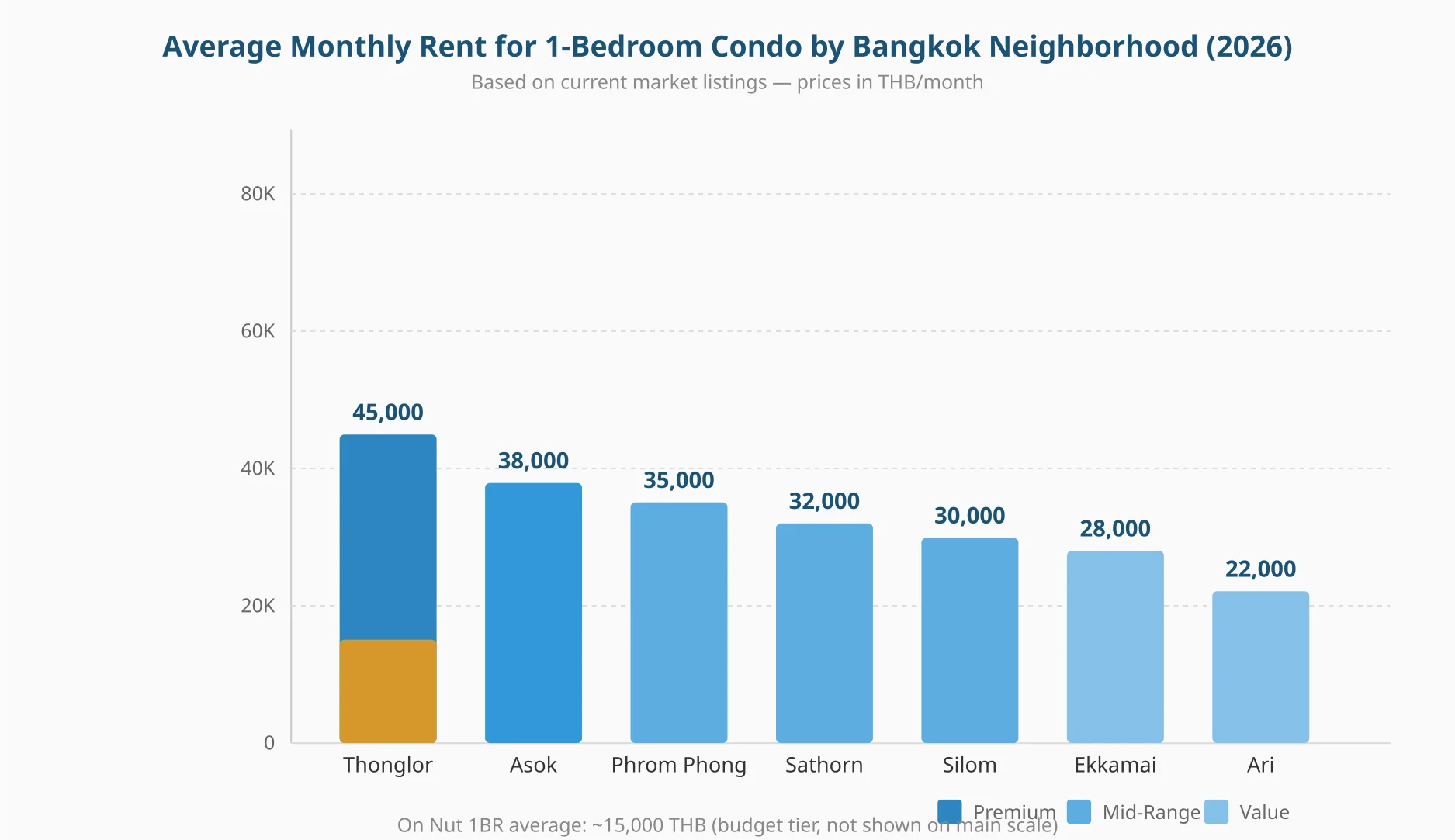
For those exploring condos and apartments in Bangkok, these figures represent the median — you'll find outliers in both directions. A luxury 1-bedroom in The Monument Thong Sanam Pao can hit 55,000 THB, while an older walk-up in On Nut can be found for 9,000 THB.
Sukhumvit Corridor: The Expat Default
When most people discuss where to live in Bangkok as an expat, they're really talking about Sukhumvit Road — the 20+ kilometer artery that runs northeast from central Bangkok. The Sukhumvit BTS line is the city's expat spine, and each station along it has a distinct personality.
Asok: The Crossroads
Asok is the intersection of the BTS Sukhumvit Line and the MRT Blue Line, making it the most connected neighborhood in Bangkok. If your job is anywhere near the CBD, Sala Daeng, or even Rama 9, Asok puts you within 15 minutes of it. The area around Terminal 21 and Soi 23 is dense with restaurants, gyms, and co-working spaces.
Typical rents: 1-bedroom condos run 30,000–40,000 THB/month. Buildings like The Address Asoke and Asok Montri Garden cater specifically to the expat market.
Best for: Corporate professionals who prioritize commute time and want everything within walking distance.
Thonglor (Thong Lo): Premium Lifestyle
Thonglor is Bangkok's most prestigious expat neighborhood. Soi Thonglor 10 and 13 are packed with Japanese restaurants, boutique fitness studios, craft coffee shops, and rooftop bars. The crowd skews affluent — Japanese expatriates, Korean professionals, and increasingly, Chinese investors.
Typical rents: 1-bedroom condos start at 40,000 THB and reach 60,000+ THB for premium buildings like The Fine Bangkok Thonglor 25 or Khun by Yoo. A 2-bedroom in a grade-A building will cost 70,000–120,000 THB.
Best for: Expats with housing allowances above 50,000 THB/month who want Bangkok's best dining and social scene outside their door.
Phrom Phong: Family-Friendly Sukhumvit
Phrom Phong flies under the radar compared to Asok and Thonglor, but it's arguably the most balanced neighborhood on the Sukhumvit line. Benjasiri Park provides green space, EmQuartier and Emporium offer premium shopping, and several international clinics are within walking distance.
Typical rents: 1-bedroom condos range from 28,000–38,000 THB. The Sukhumvit 31 area (Soi Sawatdi) has several family-oriented buildings with 2-3 bedroom units at 50,000–80,000 THB.
Best for: Families who want Sukhumvit convenience without Thonglor prices, and easy access to international schools via the Expressway.
On Nut and Phra Khanong: Value Seekers
On Nut is the traditional budget expat stronghold, and Phra Khanong is its rapidly gentrifying neighbor. On Nut retains a local market atmosphere with cheap street food, while Phra Khanong has attracted a wave of trendy cafes and co-working spaces.
Typical rents: 1-bedroom condos in On Nut run 12,000–18,000 THB. Phra Khanong is slightly more expensive at 15,000–22,000 THB. Buildings like The Room Sukhumvit 69 and Ideo Phra Khanong-Asoke are popular among younger expats.
Best for: Digital nomads, English teachers, and early-career expats on budgets under 20,000 THB/month.
Silom and Sathorn: The Financial District Play
Most guides lump Silom and Sathorn together, but they serve very different expat profiles. Knowing the difference matters when deciding where to live in Bangkok as an expat.
Silom: Urban Energy Meets Nightlife
Silom is Bangkok's original financial district, and by night, Soi Patpong transforms it into one of the city's busiest entertainment zones. The BTS Silom Line runs overhead, and the MRT Blue Line connects at Sala Daeng. Lumphini Park — Bangkok's largest central green space — borders Silom to the east.
Typical rents: 1-bedroom condos range from 25,000–35,000 THB. Buildings like Silom Suite and The Diplomat Sathorn (technically bordering Sathorn) are popular.
Consider: Silom can be noisy and congested. Air quality along Silom Road is consistently among Bangkok's worst due to traffic density, with PM2.5 levels frequently exceeding WHO guidelines during the November-February cool season (Source: Pollution Control Department, 2025). If you're sensitive to pollution, look toward the Lumphini side rather than the Charoenkrung side.
Sathorn: Embassy Row and Corporate Towers
Sathorn (also spelled Sathorn/Sathorn) is the embassy district — the Australian, Danish, Malaysian, and Singaporean embassies are all here, along with corporate headquarters like CP Group and Bangchak. The atmosphere is quieter and more corporate than Silom.
Typical rents: 1-bedroom condos run 28,000–45,000 THB. The stretch along North Sathorn Road has fewer residential options than Sukhumvit, which keeps prices elevated. Buildings like The Ritz-Carlton Residences and The Sukhothai Residences cater to the ultra-premium segment (100,000+ THB/month for 2-bedroom units).
Best for: Diplomats, senior corporate executives, and expats who work in the Sathorn corridor and value quiet evenings over nightlife.
Ari and Saphan Khwai: The Quiet Alternative
Ari is the neighborhood that Bangkok expats recommend to other expats who want to escape Sukhumvit. Located on the BTS Sukhumvit Line north of Saphan Khwai, Ari has transformed from a sleepy government-housing area into a boutique neighborhood with a distinct identity — craft coffee, independent restaurants, and a community feel that's rare in central Bangkok.
Ari's Transformation
The area around Soi Ari 1 and Ari 4 has become a mini cultural hub. The Ari neighborhood now hosts several specialty coffee roasters, a weekly farmers' market, and restaurants that rival anything on Thonglor at half the price. The nearby government housing estates keep the area grounded — you'll find 40-baht pad kra pao next to a 300-baht brunch spot.
Cost Savings vs Sukhumvit
Ari rents are typically 25-35% cheaper than comparable buildings in Asok or Phrom Phong:
| Unit Type | Ari (THB/month) | Asok (THB/month) | Savings |
|---|---|---|---|
| Studio (25-30 sqm) | 12,000–16,000 | 20,000–25,000 | ~35% |
| 1-Bedroom (35-45 sqm) | 18,000–25,000 | 30,000–40,000 | ~35% |
| 2-Bedroom (55-70 sqm) | 28,000–38,000 | 50,000–70,000 | ~40% |
Best for: Families, long-term expats, and anyone who values community character over nightlife density.
Emerging Neighborhoods: Beyond the Usual Suspects
If you're asking where to live in Bangkok as an expat and only considering Sukhumvit and Silom, you're missing areas with better value-per-sqm and strong appreciation potential.
Rama 9 / Ratchada: The New CBD
Rama 9 has been designated as Bangkok's emerging secondary CBD, anchored by G Tower, the Raintree Plaza, and the newly completed One Bangkok mega-project nearby. The area has attracted significant Chinese investment, and rents remain 20-30% below Asok for comparable buildings.
Typical rents: 1-bedroom condos run 20,000–30,000 THB. Buildings like Ideo Mobi Rama 9 and The Base Rama 9 offer good value.
The MRT Blue Line connects Rama 9 to both Silom (15 minutes) and Sukhumvit/Asok (10 minutes via interchange at Sukhumvit). The upcoming Orange Line MRT extension, expected to open in 2026-2027, will further boost connectivity eastward.
Bang Na: Eastern Expansion for Families
Bang Na is overlooked by most expat guides, but it's worth considering if you have children. Bangkok Patana School, Berkeley International School, and St. Andrews International School are all in the Bang Na/Bang Phli corridor. The BTS Sukhumvit Line extension now reaches Bang Na directly, making the commute to Asok about 25 minutes.
Typical rents: 2-3 bedroom houses and townhouses start at 30,000–50,000 THB. Condos are limited but affordable at 15,000–25,000 THB for a 1-bedroom.
Impact of New Metro Lines
Bangkok's transit network is expanding rapidly, and this is reshaping where expats choose to live:
- Yellow Line (Lat Phrao – Samrong): Opened 2023, connects eastern Bangkok to the BTS Sukhumvit Line. Areas around Lat Phrao and Si Kritha are seeing rising expat interest.
- Pink Line (Khae Rai – Min Buri): The northern orbital line, partially operational in 2026, opens up areas like Lak Si and Don Mueang.
- Orange Line (Bang Khun Non – Min Buri): The most anticipated line, running east-west through central Bangkok, will create a third major transit axis.
For forward-thinking expats, buying or renting near upcoming stations can mean significant savings now with appreciation potential as lines open.
Foreign Ownership Rules Every Expat Must Know
If you're considering buying rather than renting — and many long-term expats do — you need to understand the legal framework. This is an area where most expat guides are dangerously vague.
The 49% Condominium Quota
Under the Condominium Act of 1979 (amended 2008), foreigners can own freehold condominium units in Thailand, but foreign ownership in any single condominium building is capped at 49% of the total unit area. In popular expat buildings along Sukhumvit, this quota is often fully subscribed — meaning you can only buy a unit that a foreign owner is selling, not a developer's unsold inventory.
What most people get wrong: They assume the 49% quota applies to units, not floor area. It's floor area. A building could have 60% of its units owned by foreigners if those units are collectively under 49% of total floor area — though this rarely happens in practice.
Leasehold vs Freehold
When the foreign quota is full, developers offer leasehold contracts — typically 30 years, renewable. I've reviewed hundreds of these contracts at Knight Frank, and here's the critical issue: a 30-year leasehold is not the same as ownership. Under the Civil and Commercial Code, lease agreements exceeding 3 years must be registered with the Land Department to be enforceable beyond that period. Even registered, a 30-year lease does not automatically renew — the renewal clause is contractual, not statutory.
My recommendation: If you're buying for personal use and plan to stay 5-10 years, leasehold can make sense at a 30-40% discount to freehold. If you're buying for investment or long-term appreciation, insist on freehold and walk away if the quota is full.
Tax Implications for Buyers
- Transfer fee: 2% of the appraised value (split between buyer and seller)
- Specific Business Tax (SBT): 3.3% of appraised value or sale price (whichever is higher), paid by seller if the property was held less than 5 years
- Stamp duty: 0.5% of appraised value (paid instead of SBT if held over 5 years)
- Withholding tax: Progressive, from 5% to 35%, based on the appraised value and the seller's tenure
For rental income, individual landlords face progressive income tax rates of 5-35%. Many expats structure their rentals through a Thai company, but this introduces corporate tax obligations and annual audit requirements. (Source: Revenue Department of Thailand)
Case Study: Real Investment Results — Buying vs Renting in Thonglor
The following is based on an actual client transaction I advised on in 2022, with results tracked through 2025. Names have been omitted for privacy.
Purchase Details
In March 2022, an expat buyer (a senior executive at a multinational) purchased a 48 sqm 1-bedroom condo in a mid-tier building on Soi Thonglor 25. The purchase price was 6,500,000 THB (approximately 135,400 THB/sqm), which was slightly below the building's average at the time due to a motivated seller during the post-COVID market dip.
Rental Income and Expenses
The unit was rented to a Japanese expatriate family on a 12-month lease:
| Item | Amount (THB/year) |
|---|---|
| Gross rental income (35,000 THB/month × 12) | 420,000 |
| Condo maintenance fee (55 THB/sqm × 48 sqm × 12) | -31,680 |
| Sinking fund (one-time: 500 THB/sqm) | -24,000 (amortized over 5 years: -4,800/year) |
| Property agent fee (1 month rent, one-time) | -35,000 (amortized: -7,000/year) |
| Insurance | -3,000 |
| Repairs and maintenance | -8,000 |
| Property tax (building and land tax) | -2,400 |
| Net annual income | 363,120 |
Net Yield Analysis
Gross yield: 420,000 ÷ 6,500,000 = 6.46%
Net yield: 363,120 ÷ 6,500,000 = 5.58%
By comparison, the same 6,500,000 THB invested in a Thai bank fixed deposit in 2022 would have yielded approximately 1.5-2.0% net. The condo investment outperformed by a factor of nearly 3x — but the owner also benefited from capital appreciation. As of late 2025, comparable units in the same building were listed at 7,200,000 THB, representing an 11% capital gain over 3.5 years.
Lessons Learned
- Timing matters: Buying during the 2022 post-COVID dip secured a below-market price. In a normalized market, the net yield would have been closer to 4.5-5.0%.
- Hidden costs eat yield: The condo fee alone (31,680 THB/year) reduced gross yield by nearly a full percentage point. Always factor in maintenance fees before calculating returns.
- Tenant quality is everything: The Japanese tenant renewed for three consecutive years, eliminating void periods. One month of vacancy would have reduced net yield to 4.7%.
- Thai tenant preferences differ: Thais typically prefer 2-bedroom units, while expats prefer 1-bedrooms. An expat-oriented 1-bedroom in Thonglor has a deeper rental pool than a Thai-oriented unit in a suburban location.
For expats weighing where to live in Bangkok as an expat from an investment perspective, the Thonglor case above illustrates the math. For current listings in this area, browse Bangkok property listings to see what's available near Thonglor.

Decision Framework: Matching Your Profile to a Neighborhood
Digital Nomad Profile
Budget: 15,000–25,000 THB/month
Priorities: Co-working spaces, cafe culture, BTS access, nightlife
Top picks: Ekkamai, Phra Khanong, On Nut
Why: These areas have the best concentration of co-working spaces (The Work Project, JustCo, WeWork nearby), affordable eats, and a community of like-minded remote workers. Ekkamai edges out the others for its cafe scene and slightly more upscale feel.
Corporate Expat Profile
Budget: 35,000–60,000 THB/month (often with housing allowance)
Priorities: CBD proximity, international schools, gym/fitness, networking
Top picks: Asok, Sathorn, Silom
Why: Asok's BTS+MRT interchange makes it the most commute-efficient base. Sathorn is ideal if your office is in the financial district. Silom offers the best balance of work proximity and after-hours social life.
Retiree Profile
Budget: 20,000–40,000 THB/month
Priorities: Healthcare access, quiet environment, parks, affordability
Top picks: Ari, Sathorn, On Nut
Why: Ari's quiet streets and community feel appeal to retirees, while its BTS access ensures hospital visits to Bumrungrad or Bangkok Hospital are 15 minutes away. Sathorn offers proximity to BNH Hospital and Bangkok Christian Hospital. On Nut provides maximum affordability for fixed-income retirees.
Family with Children Profile
Budget: 40,000–80,000 THB/month
Priorities: International schools, parks, space (2-3 bedrooms), safety
Top picks: Phrom Phong, Ari, Bang Na
Why: Phrom Phong provides central convenience with Benjasiri Park and easy expressway access to schools in the Sukhumvit 71 area. Ari offers a quieter environment with larger units at lower prices. Bang Na is the play if your children attend Bangkok Patana or Berkeley International — you'll save 30-40% on rent compared to central Bangkok.
Bangkok Expat Neighborhood Comparison Matrix
| Neighborhood | 1BR Rent (THB/mo) | Transit | Walkability | Nightlife | Family-Friendly | Best For |
|---|---|---|---|---|---|---|
| Thonglor | 40,000–60,000 | BTS | ★★★★☆ | ★★★★★ | ★★★☆☆ | Premium lifestyle |
| Asok | 30,000–40,000 | BTS+MRT | ★★★★★ | ★★★★☆ | ★★★☆☆ | Corporate expats |
| Phrom Phong | 28,000–38,000 | BTS | ★★★★☆ | ★★★☆☆ | ★★★★★ | Families |
| Silom | 25,000–35,000 | BTS+MRT | ★★★★☆ | ★★★★☆ | ★★★☆☆ | CBD workers |
| Sathorn | 28,000–45,000 | BTS | ★★★☆☆ | ★★☆☆☆ | ★★★★☆ | Embassy/Diplomats |
| Ekkamai | 22,000–35,000 | BTS | ★★★★☆ | ★★★★☆ | ★★★☆☆ | Creatives/Nomads |
| Ari | 18,000–25,000 | BTS | ★★★☆☆ | ★★☆☆☆ | ★★★★★ | Quiet living/Families |
| Rama 9 | 20,000–30,000 | MRT | ★★★☆☆ | ★★★☆☆ | ★★★☆☆ | Value investors |
| On Nut | 12,000–18,000 | BTS | ★★★☆☆ | ★★☆☆☆ | ★★★☆☆ | Budget nomads |
Rental prices reflect 2026 market averages for 1-bedroom condos (28-45 sqm). Walkability and nightlife ratings based on amenity density within 1km radius. Data compiled from market listings and REIC reports.
Hidden Costs of Living in Bangkok Condos
When deciding where to live in Bangkok as an expat, the advertised rent is only part of the picture — hidden costs can add 15-20% to your monthly outlay. Here are the costs that landlords and agents rarely highlight:
Condo Maintenance Fees
Condo maintenance fees in Bangkok typically range from 40 to 80 THB per square meter per month, with luxury buildings charging 100-150 THB/sqm. For a 40 sqm 1-bedroom, that's 1,600–3,200 THB/month — but in most rental arrangements, the landlord covers this. If you're buying, budget for it.
Red flag: Some older buildings quote low maintenance fees (25-35 THB/sqm) but have underfunded sinking funds. When major repairs come (elevator replacement, roof resealing), expect special assessments of 50,000-200,000 THB per unit.
Utility Costs by District
| Utility | Typical Cost | Notes |
|---|---|---|
| Electricity (government meter) | 5-6 THB/unit | Standard rate — what most renters pay |
| Electricity (developer meter) | 7-8 THB/unit | Some buildings charge premium — always check |
| Water | 15-20 THB/unit | Typically 200-400 THB/month for 1 person |
| Internet (500 Mbps fiber) | 600-900 THB/month | AIS Fiber, True Internet, 3BB |
| Mobile data (unlimited) | 300-600 THB/month | AIS, TrueMove, dtac |
What most people get wrong: Many expats assume all electricity is billed at the government rate. In some buildings — particularly older ones and some in the Phra Khanong/On Nut area — the developer or landlord uses a sub-meter and charges 30-40% above the government rate. This can add 1,000-2,000 THB/month to your bills. Always ask before signing.
Sinking Fund and One-Time Charges
If you're buying, the sinking fund is a one-time payment of 300-600 THB/sqm at handover. For a 48 sqm unit, that's 14,400–28,800 THB. Renters don't pay this, but it affects landlord pricing decisions and indirectly your rent.
Other Monthly Costs to Budget
- Cleaning service: 2,500–4,000 THB/month (weekly cleaning)
- Condo parking: Often included, but second spaces cost 1,500–3,000 THB/month
- Gym membership: 1,500–3,500 THB/month (many condos include basic gyms)
- Motorcycle taxi (daily commute): 1,000–2,000 THB/month
- BTS/MRT (monthly pass): ~1,500 THB/month for unlimited rides on BTS
Final Recommendations
After a decade of analyzing this market, my single piece of advice for expats deciding where to live in Bangkok is this: choose your BTS or MRT station before choosing your building. Bangkok's traffic is legendary for all the wrong reasons, and a 1-kilometer distance from the station can mean 15 extra minutes of commuting each way during rush hour.
For first-time expats, I recommend renting for at least 6-12 months before considering a purchase. The market in 2026 favors renters — with high vacancy rates and landlord concessions, you have room to negotiate. If you do decide to buy, focus on freehold condos within 500 meters of a BTS or MRT station, in buildings where the foreign quota is not yet fully subscribed. You can explore Bangkok property projects and browse our Bangkok real estate platform for verified listings and project information.
The data is clear: Bangkok remains one of Asia's most affordable major cities for expats, but the gap between "good value" and "overpriced" neighborhoods is wider than ever. Do your homework, walk the soi before you sign, and never let an agent rush you into a decision.
FAQ
What is the cheapest area to live in Bangkok for expats?
On Nut and Phra Khanong offer the most affordable rents along the BTS Sukhumvit Line, with 1-bedroom condos starting at 12,000–15,000 THB/month. Further out, Lat Phrao and Bang Na have even cheaper options (8,000–12,000 THB), but commute times increase significantly. Budget 18,000–22,000 THB/month total for a comfortable single-person lifestyle in On Nut including utilities and food.
Which Bangkok neighborhood is best for families with children?
Phrom Phong is ideal for families wanting central convenience, with Benjasiri Park, premium shopping, and easy expressway access to international schools. Ari offers a quieter environment with larger units at 25-35% lower rents. For families with children at Bangkok Patana or Berkeley International School, Bang Na provides the best proximity at 30,000–50,000 THB/month for 2-3 bedroom houses.
Can foreigners buy property in Bangkok?
Yes, foreigners can buy freehold condominium units under the Condominium Act, capped at 49% foreign ownership of total floor area per building. Foreigners cannot own land directly. When the 49% quota is full, leasehold contracts (typically 30 years) are offered, but these are rental agreements, not ownership. Transfer fees are 2%, and Specific Business Tax of 3.3% applies if the property is sold within 5 years. (Source: Condominium Act B.E. 2522, Land Department)
How much does it cost to live in Bangkok as an expat per month?
A single expat can live comfortably on 40,000–60,000 THB/month total, including rent (15,000–35,000 THB), utilities (2,000–3,500 THB), food (8,000–15,000 THB), transport (2,000–4,000 THB), and miscellaneous (5,000–10,000 THB). Couples should budget 60,000–100,000 THB/month. Families with international school tuition face additional costs of 400,000–900,000 THB/year per child, depending on the institution (Source: International Schools Association of Thailand, 2025).
What is the best BTS line to live on in Bangkok?
The BTS Sukhumvit Line is the best for expats, running from Mo Chit through Asok, Thonglor, Phrom Phong, Ekkamai, and On Nut. It connects to the MRT Blue Line at Asok (interchange to Silom, Rama 9) and the MRT Yellow Line at Samrong. The Sukhumvit Line gives you access to the widest range of expat-oriented amenities, international schools, hospitals, and shopping within a 10-minute walk of most stations.
→ See live listings near Thong Lo BTS Station
Data Visualizations

Senior Real Estate Analyst
Former valuation director at Knight Frank Thailand with 12+ years analyzing Bangkok property markets. Specializes in investment analysis, market trends, and foreign ownership regulations. MBA from Thammasat University.
- Former Director, Knight Frank Thailand
- MBA Thammasat University
- 12+ years Bangkok real estate experience
- Licensed Real Estate Broker