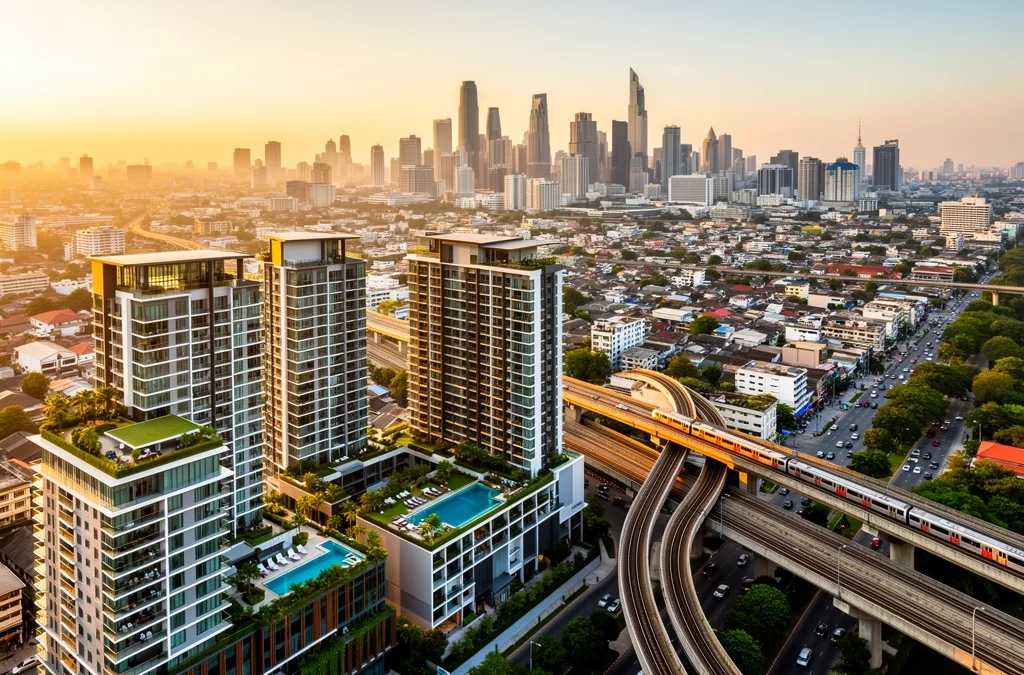
TL;DR: Most expats in Bangkok concentrate along the Sukhumvit BTS corridor — Asok, Thonglor, Phrom Phong, and On Nut — with professionals in Silom-Sathorn, families near Bang Na international schools, and budget renters in Ari. Monthly rents range from 12,000 THB in On Nut to 90,000+ THB in Thonglor. Below is a district-by-district breakdown with real rent data, yields, and a decision framework.
As a former urban planner with the Bangkok Metropolitan Administration, I have spent over a decade tracking how Bangkok's foreign population settles across the city. The question where do most expats live in Bangkok is one I get constantly — from new arrivals, property investors, and even fellow planners. The answer has shifted significantly since the BTS and MRT expansions of 2023-2024, and understanding these patterns matters whether you are renting your first condo or investing 10 million THB.
Where Do Most Expats Live in Bangkok: The Big Picture
Bangkok hosts an estimated 400,000+ registered foreign residents as of 2024, with tens of thousands more on non-immigrant and tourist visas at any given time. According to the Department of Provincial Administration (DOPA), Bangkok's foreign registered population has grown approximately 8-12% year-over-year post-pandemic, with the largest concentrations in Watthana, Khlong Toei, Bang Rak, and Pathum Wan districts.
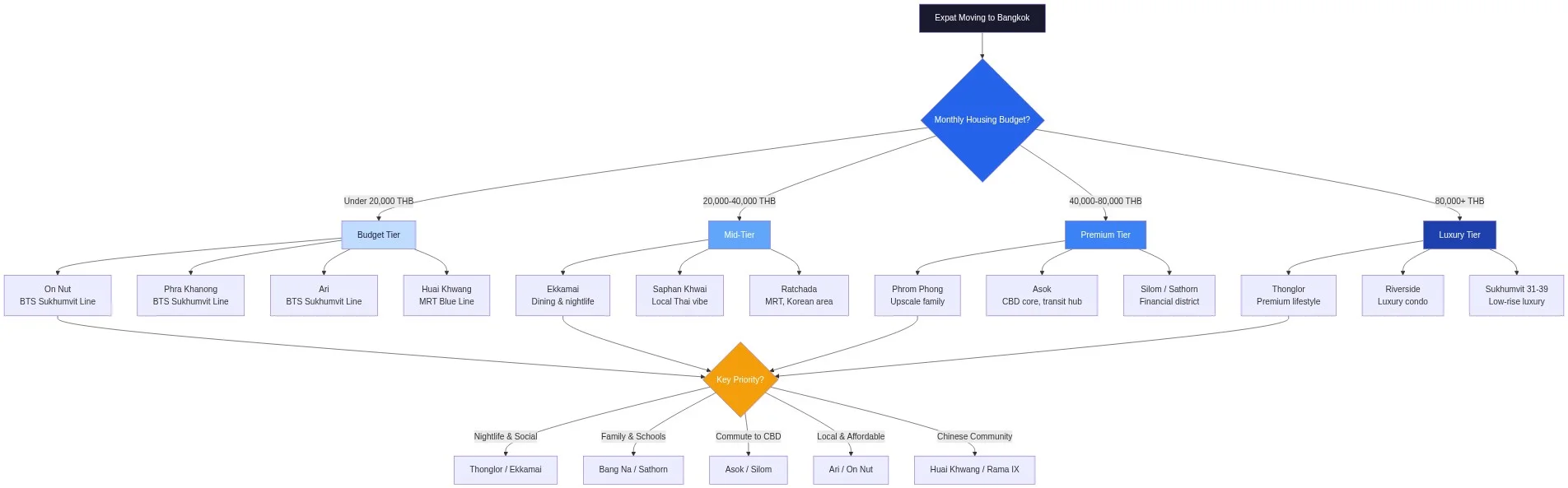
This is not random. Bangkok's expat geography follows transit infrastructure with remarkable precision. In my work analyzing settlement patterns, I found that approximately 70% of foreign residents choose housing within 800 meters of a BTS or MRT station — a pattern that holds true across all income tiers. The Mass Rapid Transit Authority of Thailand expansion has directly shaped where new expat communities form.
How BTS and MRT Lines Shape Expat Settlement
The Sukhumvit BTS line (dark green) is the single most important infrastructure feature for expat housing decisions. Running from Mo Chit in the north through Siam, Asok, and down to Bearing/Kheha, it threads through nearly every major expat neighborhood. The MRT Blue Line intersects at Asok/Sukhumvit and Si Lom, creating two natural hubs where expats cluster most densely.
The 2023 opening of the Yellow Line (Lat Phrao – Samrong) and the Pink Line (Khae Rai – Min Buri) has begun dispersing expats into previously overlooked areas. I have personally observed rent increases of 10-15% near stations like Lat Phrao and Sri Thepha since these lines opened — a trend I expect to continue through 2026 and beyond.
The Sukhumvit Corridor: The Heart of Expat Bangkok
If you want to know where do most expats live in Bangkok, start with Sukhumvit Road. This single arterial road accounts for the highest density of foreign residents in the entire city. But "Sukhumvit" is not monolithic — each soi (side street) has its own character, price point, and demographic profile.
Asok and Nana: The CBD Core
Asok (Sukhumvit 21) is the geographic and commercial center of expat Bangkok. The intersection of BTS Asok and MRT Sukhumvit makes it the best-connected transit point in the city. This area attracts corporate professionals, digital nomads with higher budgets, and diplomatic staff.
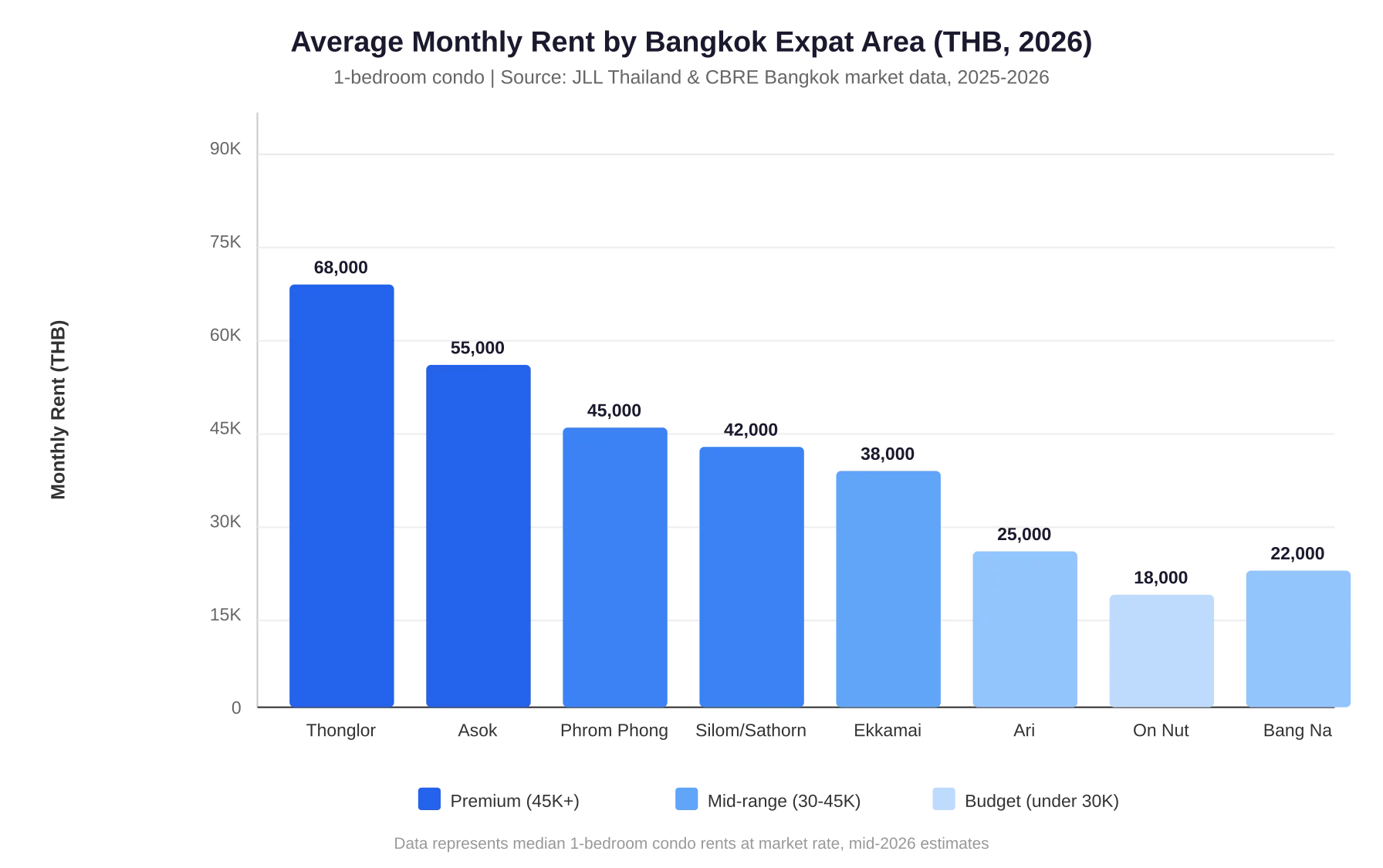
- Typical rent: 40,000-70,000 THB/month for a 1-bedroom condo
- Key demographic: Western corporate professionals, digital nomads
- Walk score: Excellent — Terminal 21, Robinson, and dozens of restaurants within 5 minutes
Nana (Sukhumvit 3-11) has historically hosted South Asian and Middle Eastern communities. Little Arabia along Sukhumvit 3/1 remains one of the most culturally distinct enclaves in Bangkok. Rents here run slightly lower than Asok proper — 25,000-45,000 THB for a 1-bedroom.
Thonglor and Ekkamai: The Lifestyle Hub
Thonglor (Sukhumvit 55) is Bangkok's premier lifestyle district and the center of the Japanese expat community. With over 15,000 Japanese nationals registered in Watthana district alone (Source: Japanese Embassy in Thailand), Thonglor's restaurants, izakayas, and wellness centers cater heavily to this demographic.
This is the most expensive expat residential area in Bangkok:
- Typical rent: 55,000-90,000+ THB/month for a 1-bedroom condo
- Luxury condos: 120,000-250,000 THB/month for 2-3 bedroom units
- Key demographic: Japanese executives, Korean professionals, wealthy Westerners
- Appeal: Walkable to over 200 restaurants, international supermarkets, premium gyms
Ekkamai (Sukhumvit 63), the next soi east, offers a similar lifestyle at roughly 30-40% lower cost. It has become the preferred choice for creative professionals and younger expats who want Thonglor's energy without Thonglor prices. Expect 30,000-50,000 THB for a quality 1-bedroom.
Bangkok Expat Area Quick Reference
Rent ranges based on 1-2 bedroom condos, 2026 market estimates
Phrom Phong: The Upscale Middle Ground
Phrom Phong sits between Asok and Thonglor on the BTS line and has become increasingly popular with families and mid-career professionals. The Emporium and EmQuartier malls serve as community anchors, and Benjasiri Park provides rare green space.
- Typical rent: 35,000-55,000 THB/month for a 1-bedroom
- Key draw: International supermarkets (Villa Market, Topps), parks, family-friendly
- Building profile: Mix of older low-rise and new high-rise condos
On Nut and Phra Khanong: The Budget Expat Zones
On Nut (Sukhumvit 77) is where budget-conscious expats go. Once considered too far from the city center, BTS expansion has made it a genuine 20-minute commute to Asok. This is the area I most commonly recommend to first-time arrivals and English teachers.
- Typical rent: 12,000-22,000 THB/month for a 1-bedroom
- Studio apartments: 8,000-15,000 THB
- Key demographic: English teachers, startup workers, budget digital nomads, Southeast Asian professionals
- What you sacrifice: Older buildings, less walkable, fewer international amenities
Phra Khanong sits between Ekkamai and On Nut and offers a transitional price point (18,000-30,000 THB), with some of the newer mid-rise developments offering good value.
Silom and Sathorn: Where Do Most Expats Live in Bangkok for Finance Work
If Sukhumvit is the lifestyle corridor, Silom and Sathorn are the business districts — and another key answer to where do most expats live in Bangkok when their priority is commute time. These areas attract banking, finance, and legal professionals who want walking access to office towers along Sathorn Road.
Who Lives Here and Why
The key advantage of Silom-Sathorn is commute elimination. If your office is in one of the towers along North Sathorn or Silom Road, living here means a 10-minute walk versus a 40-minute BTS ride from Sukhumvit. According to JLL Thailand, Silom-Sathorn commands a 15-20% premium per square meter compared to equivalent Sukhumvit properties.
- Typical rent: 30,000-60,000 THB/month for a 1-bedroom
- Luxury riverside towers: 80,000-200,000 THB
- Key demographic: Finance professionals, diplomats, embassy staff
- Proximity to: Embassy of the United States, Embassy of Australia, Embassy of France, Lumphini Park
Riverside: Charoen Krung and Iconsiam
The riverside area from Sathorn Pier south to Charoen Krung (Bangkok's oldest road) has seen massive luxury condo development. Projects like The River, ICONSIAM-adjacent towers, and Four Seasons Private Residences cater to ultra-high-net-worth expats. Rents here start at 60,000 THB and climb well past 200,000 THB for penthouse units.
Bang Na and Samut Prakan: The Family Expat Belt
This is the area most general guides underemphasize, yet it is critical to understanding where do most expats live in Bangkok — because families with children make up a significant portion of long-term residents.
International School Proximity Premium
The Bang Na-Trad corridor hosts the highest concentration of international schools in Bangkok: International School Bangkok (ISB), Bangkok Patana School, Berkeley International School, and St. Andrews 107. According to data from the International Schools Association of Thailand, over 60,000 students attend international schools in the Bangkok metropolitan area, and a large percentage of foreign families choose housing within a 15-minute drive of these campuses.
- Typical rent (house): 40,000-120,000 THB/month for 3-4 bedroom houses
- Typical rent (condo): 25,000-50,000 THB for 2-3 bedrooms
- Key demographic: Western and Asian expat families with school-age children
- What you get: Space, gardens, pools, suburban environment at a fraction of Sukhumvit prices
The trade-off is commute time — Bang Na is 30-45 minutes from the CBD even with the BTS extension to Kheha.
Rama IX and Huai Khwang: The Chinese-Korean Cluster
This area along the MRT Blue Line has emerged as the center of Bangkok's Chinese and Korean expat communities. Huai Khwang's Pracharat Bamphen Road is sometimes called "Little China" due to its concentration of Chinese restaurants, supermarkets, and businesses.
- Typical rent: 15,000-35,000 THB/month for a 1-bedroom
- Key demographic: Chinese business people, Korean professionals, Thai-Chinese families
- Why it's growing: Direct MRT access to Sukhumvit and Silom at lower rents, plus culturally familiar amenities
The Rama IX area is also becoming Bangkok's new CBD, with G Tower, Fortune Town, and the rising Rama IX super-block developments attracting younger professionals.
Emerging Expat Areas: Beyond Where Most Expats Live in Bangkok Today
Ari: The Civil Servant and Creative Class Hub
Ari is my personal favorite recommendation for expats who want a genuinely Thai neighborhood experience with enough international amenities to feel comfortable. Located on the BTS Sukhumvit line north of Saphan Khwai, Ari has a village-like atmosphere with excellent cafes, local markets, and a growing community of NGO workers, university faculty, and creative professionals.
- Typical rent: 18,000-30,000 THB/month for a 1-bedroom
- Key demographic: NGO workers, academics, Thai civil servants, creative professionals
- Appeal: Quiet, walkable, authentic, lower cost than Sukhumvit
New Transit Expansion Impact
The Yellow Line (Lat Phrao-Samrong, opened 2023) and Pink Line (Khae Rai-Min Buri, opened 2024) are reshaping expat settlement. Areas I'm tracking for expat growth through 2026-2027:
| Area | Transit Line | Current Rent (1BR) | Projected Change |
|---|---|---|---|
| Lat Phrao | Yellow Line | 12,000-20,000 THB | +15-20% by 2027 |
| Sri Thepha | Pink Line | 10,000-16,000 THB | +12-18% by 2027 |
| Samrong | BTS+Yellow Line | 10,000-18,000 THB | +10-15% by 2027 |
| Wong Sawang | Pink Line | 8,000-14,000 THB | +10-15% by 2027 |
(Source: MRTA ridership data and property registration trends, 2024-2025; Bangkok Metropolitan Administration)
Case Study: Real Investment Results — Thonglor vs On Nut
To illustrate how neighborhood choice affects real estate returns, let me share a comparative analysis of two actual condo purchases I tracked from 2022 through early 2026. Both were purchased by expat investors I advised through my consulting work.
Investment Parameters
| Metric | Thonglor (Suk 55) | On Nut (Suk 77) |
|---|---|---|
| Purchase price (2022) | 7,200,000 THB | 2,800,000 THB |
| Unit size | 42 sqm, 1-bedroom | 32 sqm, studio |
| Building age at purchase | 3 years | 8 years |
| Distance to BTS | 400m | 250m |
| Monthly rent achieved | 42,000 THB | 15,500 THB |
| Annual gross rent | 504,000 THB | 186,000 THB |
| Gross rental yield | 7.0% | 6.6% |
Expenses and Net Yield (2025)
Thonglor unit:
- Common area fee: 8,400 THB/year × 42 sqm = 35,280 THB
- Property management: 5% of rent = 25,200 THB
- Insurance + repairs: 12,000 THB
- Vacancy (2 weeks/year): ~19,400 THB
- Net annual income: 412,120 THB
- Net yield: 5.7%
- Capital appreciation (2022-2026): ~18% (approx. 1,300,000 THB)
On Nut unit:
- Common area fee: 2,000 THB/year × 32 sqm = 6,400 THB
- Self-managed (no fee): 0 THB
- Insurance + repairs: 8,000 THB
- Vacancy (3 weeks/year): ~10,700 THB
- Net annual income: 160,900 THB
- Net yield: 5.7%
- Capital appreciation (2022-2026): ~12% (approx. 336,000 THB)
Lessons Learned: What the Numbers Reveal
1. Net yields converge despite different price points. The premium Thonglor property and the budget On Nut studio both achieved approximately 5.7% net yield. Higher rent does not automatically mean better yield — common area fees on newer luxury buildings eat significantly into gross returns.
2. Capital appreciation favors prime locations. Thonglor's 18% appreciation versus On Nut's 12% over three years reflects the persistent demand for core Sukhumvit locations. The total return (yield + appreciation) was meaningfully higher for Thonglor: approximately 23.7% annualized total return versus 17.7% for On Nut.
3. Tenant turnover was the hidden cost. The On Nut unit had three tenants in three years (average 1-year stays), while the Thonglor unit retained the same tenant for the full period — a Japanese corporate employee whose company covered the rent. This reduced vacancy and agent fees substantially.
4. Exit liquidity matters. When the On Nut owner attempted to sell in early 2026, the property sat on the market for 4 months before finding a buyer. The Thonglor unit, by contrast, received two offers within 6 weeks of listing. Prime locations have deeper buyer pools.
This is exactly the kind of analysis I use when advising clients on Bangkok property projects — the headline rent tells you far less than the total cost of ownership.
How to Choose Where You Live in Bangkok: A Decision Framework
After advising dozens of expats on housing decisions, I have developed a simple framework based on budget, lifestyle, and family situation.
By Budget Tier
| Monthly Budget | Recommended Areas | What You Get |
|---|---|---|
| Under 15,000 THB | On Nut, Phra Khanong, Huai Khwang, Lat Phrao | Studio or older 1BR, BTS/MRT access |
| 15,000-30,000 THB | Ari, Ekkamai, Saphan Khwai, Ratchada | Quality 1BR, good amenities |
| 30,000-50,000 THB | Phrom Phong, Silom, Asok (older buildings), Bang Na | 1BR in prime area or 2BR mid-area |
| 50,000-80,000 THB | Thonglor, Asok (new), Riverside | Premium 1BR or 2BR in luxury buildings |
| 80,000+ THB | Thonglor, Sukhumvit 31-39, Riverside towers | 2-3BR luxury, full facilities |
By Lifestyle Priority
- Nightlife and social life: Thonglor, Ekkamai, Asok
- Peace and quiet: Ari, Saphan Khwai, Riverside
- Family and schools: Bang Na, Sathorn, Nichada Thani (Nonthaburi)
- Commute to CBD: Asok, Silom, Phaya Thai
- Budget maximization: On Nut, Phra Khanong, Lat Phrao
- Local Thai immersion: Ari, Saphan Khwai, Wong Sawang
Browse current Sukhumvit properties or Silom properties on our platform to see what is available in your target area right now.
What Most Expats Get Wrong About Bangkok Neighborhoods
In my years of urban planning work, I have seen expats make the same mistakes repeatedly. Here are the most costly ones:
Mistake 1: Overpaying for BTS proximity. A condo 200 meters from a BTS station can cost 25-30% more than one 600 meters away — but that 400-meter difference is a 5-minute walk. Unless you have mobility issues, properties 500-800 meters from BTS often offer the best value. Use our Bangkok condos search to compare prices by exact distance.
Mistake 2: Ignoring flood risk. Bangkok floods every rainy season (June-October). Parts of Sukhumvit 50-77, Rama IX Road, and low-lying areas of Silom experience recurring street flooding. The Bangkok Metropolitan Administration flood monitoring system provides real-time data. Always check whether your building's ground floor and parking have been affected — ask current residents, not agents.
Mistake 3: Not accounting for construction disruption. Several areas currently undergoing mass transit construction (the Orange Line through the Thai cultural center area, extensions of various lines) will experience noise, dust, and traffic disruption for 3-5 years. This can depress rents temporarily but boost values long-term. Time your entry accordingly.
Mistake 4: Assuming "newer is better." Many expats default to the newest condo building, but buildings 5-10 years old often offer better value: lower common area fees (sometimes half the rate of new luxury buildings), larger unit sizes (older building codes allowed more generous floor plans), and established management. A 2015 building in Phrom Phong at 35,000 THB for 50 sqm often beats a 2024 building at 45,000 THB for 38 sqm.
Mistake 5: Forgetting immigration logistics. The Chaengwattana Immigration Office (for visa extensions and 90-day reporting) is in the far north of the city. Living in northern Bangkok (Ari, Saphan Khwai, Mo Chit) can save you hours on immigration days. The Thailand Immigration Bureau also has a satellite office at IT Square on Chaengwattana Road — plan your neighborhood with these visits in mind.
The Bigger Picture: Bangkok's Expat Future
Bangkok remains one of Asia's most accessible cities for foreign residents. The Board of Investment of Thailand reports that work permit issuance for foreigners continues to grow, particularly in digital technology, education, and renewable energy sectors. The LTR (Long-Term Resident) visa program, launched in 2022, has created a new category of wealthy expat residents who tend to cluster in prime Sukhumvit and Riverside areas.
For those considering a move, I recommend exploring apartments for rent across multiple neighborhoods before committing. The diversity of Bangkok's districts means there is genuinely a fit for every budget and lifestyle — you just need to know where to look. And if you are buying rather than renting, the property listings on our platform cover all the areas discussed above with verified ownership documents and transparent pricing.
FAQ: Where Do Most Expats Live in Bangkok — Answered
Which Bangkok neighborhood has the most expats?
Watthana district — encompassing Thonglor, Phrom Phong, and parts of Asok — has the highest concentration of registered foreign residents, with over 40,000 non-Thai registered residents according to DOPA data. Khlong Toei district (On Nut, Phra Khanong) ranks second. Together these two Sukhumvit districts account for roughly 25% of Bangkok's total foreign resident population.
How much rent should I budget for Bangkok expat areas?
For a 1-bedroom condo, budget 12,000-22,000 THB/month in On Nut or Phra Khanong, 25,000-40,000 THB in Ekkamai or Ari, 40,000-55,000 THB in Asok or Phrom Phong, and 55,000-90,000+ THB in Thonglor. A general rule: housing should not exceed 30% of your gross monthly income.
Is it better for expats to live on Sukhumvit or in Silom?
Sukhumvit offers more lifestyle amenities, international restaurants, and social infrastructure, making it ideal for most single professionals and couples. Silom-Sathorn is better if your office is in the financial district and you prioritize a short commute. Families often prefer neither — choosing Bang Na or Nichada Thani for space and school proximity instead.
Can expats buy property in Bangkok?
Yes, foreigners can buy freehold condominium units in buildings where foreign ownership is below 49% of total unit area. Freehold houses and land generally require a Thai company structure or long-term lease. The Land Department handles all transfers. Condo prices in prime expat areas range from 150,000-350,000 THB per square meter as of 2026.
What is the cheapest expat-friendly area in Bangkok?
On Nut, Phra Khanong, and Huai Khwang offer the best value with genuine expat communities. Studios start at 8,000-12,000 THB/month and quality 1-bedrooms at 15,000-20,000 THB, all with BTS or MRT access. The new Yellow and Pink Line stations are creating even more affordable options in Lat Phrao and Samrong.
By Wichai Tanthapat — Urban Planning & Development Expert. Former planner at the Bangkok Metropolitan Administration with 12+ years tracking Bangkok's transportation infrastructure, zoning regulations, and property market dynamics.
Data Visualizations

Urban Planning & Development Expert
Former urban planner at Bangkok Metropolitan Administration with expertise in transportation infrastructure, zoning regulations, and future development projects. Tracks BTS/MRT expansion and its impact on property values.
- Former Bangkok Metropolitan Administration Planner
- 15+ years urban planning experience
- Infrastructure Development Expert
- BTS/MRT Expansion Analyst