TL;DR: Renting a condominium in Bangkok costs 10,000–150,000 THB per month depending on area, size, and BTS/MRT proximity. Budget 3 months' rent upfront (2 months deposit + 1 month advance). Sukhumvit, Silom, and Sathorn remain top expat choices, while emerging areas like On Nut offer better value. Browse Bangkok condos on our platform to find your ideal unit.
Bangkok Condominium Rental Market Overview 2025-2026
When I first started consulting foreign clients on condominium Bangkok rent options back in 2017, the market looked very different from today. The pandemic reshaped demand patterns, and we are now seeing a stabilized — though shifting — rental market in 2025-2026.
Bangkok's population reached approximately 11.4 million as of 2024, with the broader Metropolitan Region housing over 17.4 million people — roughly 25% of Thailand's entire population (Source: Bangkok - Wikipedia). This massive urban concentration drives continuous demand for quality condominium housing.
The Real Estate Information Center (REIC) reported that Bangkok's condominium supply stood at approximately 590,000 units as of late 2024, with roughly 30,000 new units entering the market annually (Source: REIC, 2024). This sustained supply has kept rental prices relatively stable — a tenant's market in most mid-range segments.
Current Market Conditions
The average condominium Bangkok rent has increased by approximately 3-5% year-on-year in prime areas like Sukhumvit and the CBD, while suburban locations connected to the new BTS extensions have seen steeper increases of 8-12% as infrastructure improvements attract tenants seeking more space for less money.
Post-Pandemic Recovery Trends
After the significant rent reductions of 2020-2021 (some areas saw 15-20% drops), the market has largely recovered. However, demand has shifted. In my consulting practice, I have noticed that tenants now prioritize:
- Larger unit sizes — the work-from-home trend means studios are less popular than pre-pandemic
- Buildings with reliable internet infrastructure and co-working spaces
- Outdoor amenities — rooftop gardens, pools, and fitness facilities are deal-breakers for many
- Locations with multiple transit options, reducing reliance on a single BTS line
Supply and Demand Dynamics
The Bank of Thailand monitors property market indicators and has noted that the condominium oversupply in certain Bangkok corridors (particularly along the Sukhumvit extension past Bearing) continues to exert downward pressure on rents in those specific sub-markets. Conversely, the CBD core (Silom, Sathorn, central Sukhumvit) maintains strong demand with occupancy rates above 85% in grade-A buildings.
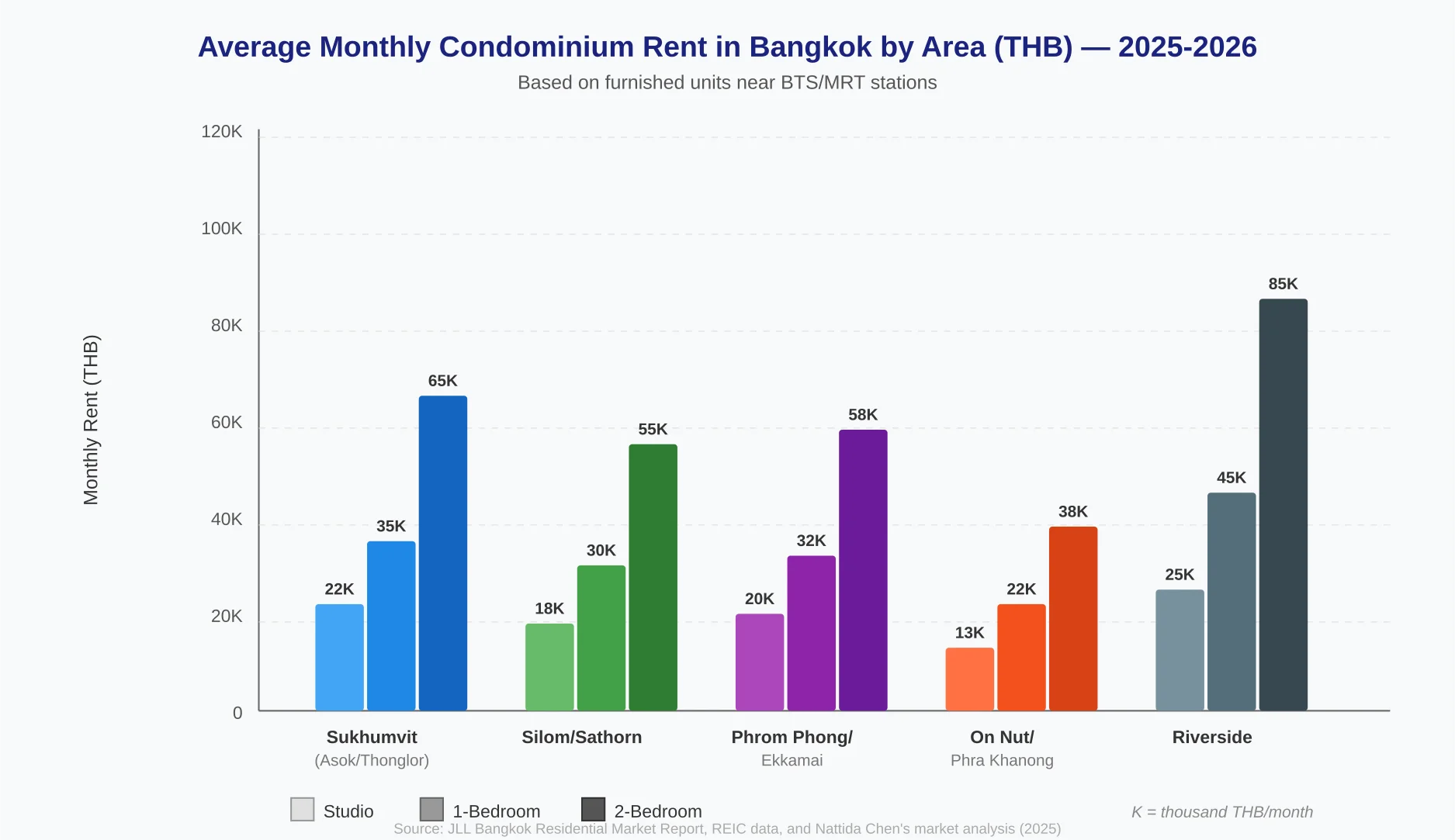
Average Condominium Bangkok Rent Prices by Neighborhood
This is the question I get asked most often: "How much should I budget for rent in [specific area]?" Below is my breakdown based on current market data from my active property listings and recent transaction records.
Sukhumvit Area (Asok, Thonglor, Phrom Phong, Ekkamai)
Sukhumvit Road remains the undisputed heart of Bangkok's expat community. Named after the fifth chief of Thailand's Department of Highways and opened in 1936, this major thoroughfare serves as the city's primary commercial artery (Source: Sukhumvit Road - Wikipedia).
| Unit Type | Monthly Rent Range (THB) | Best BTS Stations |
|---|---|---|
| Studio (25-35 sqm) | 18,000 – 28,000 | Asok, Phrom Phong |
| 1-Bedroom (40-55 sqm) | 28,000 – 45,000 | Thonglor, Ekkamai |
| 2-Bedroom (60-90 sqm) | 45,000 – 80,000 | Phrom Phong, Asok |
| 3-Bedroom (100+ sqm) | 80,000 – 180,000 | Thonglor, Phrom Phong |
Asok (BTS Asok / MRT Sukhumvit) commands the highest rents in this corridor due to its interchange status and proximity to Terminal 21 and the CBD. Thonglor (Thong Lo) attracts a younger, trendier demographic with its concentration of Japanese restaurants, boutique fitness studios, and nightlife — expect to pay a 10-15% premium here compared to neighboring Phrom Phong.
What most people get wrong: Many tenants assume all of "Sukhumvit" is the same. In reality, there is a dramatic price cliff around On Nut (BTS On Nut) going eastward. A 1-bedroom unit in Asok averages 35,000 THB, while a comparable unit near Bearing (just 8 BTS stops away) can be found for 15,000–18,000 THB.
Silom and Sathorn CBD
The traditional financial district remains popular with corporate expats and banking professionals. Silom offers a more urban, fast-paced lifestyle with excellent daytime amenities but quieter evenings compared to Sukhumvit.
| Unit Type | Monthly Rent Range (THB) | Notes |
|---|---|---|
| Studio | 15,000 – 25,000 | Older buildings cheaper |
| 1-Bedroom | 25,000 – 40,000 | Lumpini Park proximity adds premium |
| 2-Bedroom | 40,000 – 70,000 | Family-oriented buildings limited |
Riverside and Sathorn
Riverside condominiums offer some of Bangkok's most spectacular views and tend to attract a more premium, often older demographic. Buildings like those along Charoen Krung Road and near the Chao Phraya River command premium rents.
- Studio: 22,000 – 30,000 THB
- 1-Bedroom: 38,000 – 55,000 THB
- 2-Bedroom: 60,000 – 100,000+ THB
Emerging Areas: On Nut, Phra Khanong, Bang Na
These areas represent the best value for condominium Bangkok rent seekers. The BTS Sukhumvit Line extension has transformed formerly sleepy neighborhoods into viable expat enclaves:
- On Nut: 1-bedrooms from 15,000–22,000 THB. Excellent local food scene, still only 15 minutes to Asok
- Phra Khanong: 1-bedrooms from 14,000–20,000 THB. Up-and-coming with new mall developments
- Bang Na: Studios from 8,000–12,000 THB. Best for budget-conscious renters or families wanting more space
I always tell my clients: if you are willing to commute 20-25 minutes by BTS instead of living at the station, you can cut your rent by 40-50%. Explore Sukhumvit properties to compare options across the corridor.
How to Rent a Condominium in Bangkok: Step-by-Step Process

Required Documents for Foreigners
As a foreign tenant in Thailand, you will need the following documents when signing a lease:
- Passport — original and copies of the photo page and current visa page
- Visa or Work Permit — most landlords require at least a non-immigrant visa; work permit holders have stronger negotiating position
- Employment letter or proof of income — some buildings require this for foreign tenants, particularly in grade-A developments
- Previous landlord reference — optional but can help with negotiations
Understanding the Rental Agreement
Thai residential leases for condominiums typically follow a standard template, but I always review contracts for my clients. Key elements to verify:
- Lease term: 12 months is standard; 6-month leases exist but often carry a 10-15% premium
- Deposit terms: Two months' deposit is standard; this must be returned within 7-30 days of lease termination
- Utilities: Confirm who sets the electricity/water rates — some buildings mark up government rates
- Termination clause: Most leases require 30-60 days' notice; early termination may forfeit deposit
- Subletting: Almost universally prohibited without written landlord consent
Under Thai law, residential leases shorter than three years do not require registration with the Land Department (Source: Land Department of Thailand). This means most standard one-year condominium rental agreements are simply bilateral contracts between landlord and tenant.
Deposits and Upfront Costs
The standard upfront payment structure in Bangkok is:
- 1 month advance rent (your first month's rent, paid at signing)
- 2 months security deposit (refundable at lease end, minus any deductions for damage)
- Total: 3 months' rent at signing
For a 30,000 THB/month condo, you will need 90,000 THB at the lease signing. This is non-negotiable in most cases, though I have occasionally negotiated split-payment arrangements for long-term tenants in higher-rent units.
Hidden Costs and Fees When Renting Bangkok Condos
The headline rent is just the beginning. I have seen too many tenants shocked by their first month's actual out-of-pocket costs. Here is what you need to budget for:
📋 Bangkok Condo Rental Cost Calculator
Example: 1-Bedroom condo in Asok (Sukhumvit), 45 sqm, furnished
| Cost Item | Monthly Amount (THB) |
|---|---|
| Base Rent (furnished 1BR, Asok) | 35,000 |
| Electricity (MEA, ~6 units/day) | 2,500 |
| Water | 300 |
| Internet (Fiber 500Mbps) | 650 |
| Common Area Maintenance (CAM) | Included in rent |
| Parking (1 space) | Included in rent |
| Condo Facilities (pool, gym, garden) | Included in rent |
| Building Insurance (optional) | 200 |
| Total Monthly Living Cost | 38,650 |
⚠️ Upfront Payment at Signing: 3 months × 35,000 = 105,000 THB (1 month advance rent + 2 months security deposit). Deposit is refundable at lease end if no damage.
Common Area Maintenance (CAM) Fees
For tenants, CAM fees are typically already included in the rent — the landlord pays these to the building management. However, always verify this. CAM fees in Bangkok generally range from 40-80 THB per square meter per month. For a 50 sqm unit, that is 2,000-4,000 THB monthly that the landlord absorbs.
Utilities: Water and Electricity Rates
Electricity is billed by the Metropolitan Electricity Authority (MEA) for Bangkok proper, or the Provincial Electricity Authority (PEA) for surrounding areas. If your condo sub-meters through the building (common in many condominiums), you may pay a slightly higher rate:
- Direct MEA billing: ~4.0 THB per unit (kWh) as of 2025
- Building sub-metered: 5.0–8.0 THB per unit (the markup covers building administration)
For a 1-bedroom unit with normal air conditioning usage (evening only), expect 1,500–3,000 THB monthly.
Water is inexpensive — typically 200–500 THB monthly for a 1-bedroom. Buildings charge 15–25 THB per unit of water consumed.
Internet and Cable
Bangkok has excellent fiber internet infrastructure. Providers include AIS Fiber, True Online, and 3BB:
- 300 Mbps fiber: ~550–650 THB/month
- 500 Mbps fiber: ~700–800 THB/month
- 1 Gbps fiber: ~1,000–1,200 THB/month
Most condominiums are pre-wired, making installation a simple 1-2 day process.
Parking Fees
One parking space is typically included with 1-bedroom and larger units in most buildings. Studios may not include parking or may charge 1,000–2,500 THB/month for a space. Always confirm parking allocation before signing.
Case Study: Investor Rental Yield Analysis — Asok 1-Bedroom Condo
In my consulting practice, I recently helped a Singaporean investor analyze the real returns on a condominium Bangkok rent investment. Here are the actual numbers from a transaction completed in early 2025:
Purchase Details
- Location: Asok (Sukhumvit Soi 21), 300m from BTS Asok
- Unit type: 1-bedroom, 48 sqm, fully furnished
- Purchase price: 6,800,000 THB (approximately 141,667 THB/sqm)
- Transfer fees and taxes (split 50/50): ~210,000 THB
- Total investment: 7,010,000 THB
Rental Income Breakdown
- Monthly rent (furnished, 12-month lease): 35,000 THB
- Gross annual rental income: 420,000 THB
- Gross rental yield: 6.0% (on purchase price)
Operating Expenses (Annual)
| Expense Item | Annual Amount (THB) |
|---|---|
| Common Area Maintenance (48 sqm × 55 THB) | 31,680 |
| Sinking fund (amortized) | 2,400 |
| Property insurance | 3,000 |
| Agent fee (1 month rent, new tenant placement) | 35,000 |
| Furniture depreciation/replacement reserve | 15,000 |
| Property management fee (8% of rent) | 33,600 |
| Minor repairs and maintenance | 10,000 |
| Total annual expenses | 130,680 |
Net Yield Calculation
- Net annual rental income: 420,000 − 130,680 = 289,320 THB
- Net rental yield: 289,320 ÷ 7,010,000 = 4.13%
- Monthly net cash flow: ~24,110 THB
Lessons Learned
This case illustrates several important points that I share with all my investor clients:
- Gross yield is misleading. The 6.0% gross yield drops to 4.13% after expenses. Always calculate net yield.
- Location matters enormously. Asok's 6.0% gross yield is actually above average for central Bangkok. Many Sukhumvit units yield only 3.5–5.0% gross.
- Vacancy risk is real. This calculation assumes 100% occupancy. Budget for at least 1 month of vacancy per year — that drops the net yield to approximately 3.8%.
- Furnished units rent faster. The 200,000 THB furniture investment was recovered in the first 6 months through faster tenant placement and a 15-20% rent premium.
- Tax considerations. Foreign owners must understand that rental income is subject to Thai income tax (progressive rates from 5-35%). This further reduces net returns.
For investors looking to browse available investment properties, check Bangkok property projects for new developments and off-plan opportunities.
Best Bangkok Neighborhoods for Different Tenant Profiles
Not every area suits every tenant. After 8+ years of matching clients to neighborhoods, here are my profile-specific recommendations:
Digital Nomads and Remote Workers
Best areas: Ekkamai, Phrom Phong, Ari
Budget: 18,000–30,000 THB/month for a 1-bedroom
Why: These areas offer excellent co-working spaces, reliable fiber internet, good café culture, and are slightly removed from the tourist-heavy zones. Ekkamai's creative energy and Ari's quieter, local feel both appeal to location-independent professionals.
Corporate Expats and Families
Best areas: Silom, Sathorn, Sukhumvit (Asok, Phrom Phong)
Budget: 35,000–80,000+ THB/month
Why: Proximity to international schools (ISB, NIST, Bangkok Patana shuttle routes), embassies, and corporate offices. Family-friendly buildings with larger 2-3 bedroom units, playgrounds, and children's pools are concentrated in these areas. Explore Silom properties for CBD-adjacent options.
Students and Young Professionals
Best areas: On Nut, Phra Khanong, Huai Khwang, Ratchathewi
Budget: 8,000–18,000 THB/month
Why: These neighborhoods offer the best value per square meter while maintaining good BTS/MRT connectivity to universities and business districts. The local food scene is excellent and very affordable.
Retirees
Best areas: Riverside, Sathorn, Bang Na (for retirement village options)
Budget: 20,000–50,000 THB/month
Why: Quieter environments, proximity to international hospitals (Bumrungrad, Bangkok Hospital, Siriraj), and walkable neighborhoods. Riverside offers a calmer pace of life with spectacular views.
Tenant Rights and Legal Protections in Thailand
Understanding your legal position when securing a condominium Bangkok rent agreement is crucial. Thailand's landlord-tenant framework is relatively landlord-friendly, but tenants do have important rights.
Consumer Protection Board Lease Regulations
Since 2018, Thailand's Consumer Protection Board (CPB) has regulated residential lease agreements for properties where the landlord leases out five or more residential units. Key protections include:
- Deposit return: The landlord must return the deposit (minus legitimate deductions) within 7 days of lease termination, or within 30 days if a dispute exists (Source: Consumer Protection Board, Thailand)
- Maximum deposit: Capped at 1 month's rent for the security deposit plus 1 month advance rent (note: many condominiums still charge 2 months deposit — buildings with fewer than 5 rental units are exempt)
- Prohibited clauses: The CPB voids certain unfair terms, including excessive penalty clauses and automatic forfeiture of deposits
Practical Deposit Protection Tips
From my experience handling hundreds of lease transactions:
- Always document the unit condition at move-in — photograph every room, wall, fixture, and appliance with date-stamped photos
- Get everything in writing — verbal agreements have little legal standing in Thai courts
- Request a bilingual lease if you do not read Thai, but note that the Thai version is legally binding in case of disputes
- Keep a signed inventory list of all furniture and appliances provided
Dispute Resolution
If a landlord refuses to return your deposit, your options include:
- Filing a complaint with the Consumer Protection Board — free service for regulated leases
- Small claims court at the district court level
- Mediation through the Thai Arbitration Institute
Most disputes are resolved through negotiation. I have only seen two cases in my career escalate to formal legal proceedings — both involved landlords attempting to withhold deposits for "normal wear and tear," which is not legally permissible.
Tips for Negotiating Better Rental Terms
When it comes to condominium Bangkok rent negotiations, I have saved clients thousands of baht using these strategies. Here is what actually works:
Timing Your Search
The Bangkok rental market has clear seasonal patterns:
- Peak demand (highest rents): January-March (post-holiday corporate relocations) and August-September (before the new school year)
- Low demand (best deals): June-July and November-December
- Best negotiation window: End of month, when landlords and agents face vacancy pressure
Negotiation Strategies That Work
- Offer a longer lease. Landlords love stability. Offering 18 or 24 months can secure a 5-8% rent reduction.
- Pay multiple months in advance. Offering 3-6 months' rent upfront is a powerful tool for a 5-10% discount.
- Negotiate furniture. Rather than asking for lower rent, ask the landlord to add a washing machine, upgrade the air conditioning, or install a new mattress. This costs the landlord less than a rent reduction but adds significant value for you.
- Use comparable listings. Show the agent or landlord 3-5 similar units at lower prices. This is the most effective negotiation tool — price competition is respected in Thai business culture.
Working with Agents vs. Direct Landlords
In Bangkok, agents are free for tenants — the landlord pays the agent fee (typically 1 month's rent for a 12-month lease). There is no financial advantage to going direct. In fact, agents often have access to units not publicly listed and can negotiate more effectively because they have established relationships with landlords.
Browse property listings on our platform to find vetted condominiums across Bangkok, or contact me directly for personalized assistance with your search.
Frequently Asked Questions
How much is rent for a condominium in Bangkok?
For anyone researching condominium Bangkok rent options, prices range from 8,000 THB/month for a studio in suburban areas like Bang Na to over 150,000 THB/month for luxury 2-3 bedroom units in prime Sukhumvit (Asok, Thonglor) or riverside locations. Most expats budget 20,000–40,000 THB monthly for a comfortable 1-bedroom unit near a BTS station. Prime CBD areas (Silom, Sathorn) command 25,000–50,000 THB for comparable units.
Can foreigners rent condominiums in Bangkok?
Yes, foreigners can freely rent condominiums in Bangkok with no legal restrictions. You will need a valid passport and visa; a work permit strengthens your application but is not mandatory. Most landlords require 2 months' deposit plus 1 month's advance rent at signing. The process is straightforward and typically takes 3-7 days from initial viewing to lease signing.
Is rent in Bangkok expensive?
Compared to Singapore, Hong Kong, or Tokyo, Bangkok rent is very affordable. A quality 1-bedroom condo in central Bangkok costs 25,000–35,000 THB (approximately $700–$1,000 USD) per month, versus $2,500–$4,000 in those other Asian cities. The rent-to-salary ratio for most expats in Bangkok is favorable, with many spending 20-30% of their income on housing.
Which Bangkok area is best for renting a condo?
The best area depends on your lifestyle and budget. Sukhumvit (Asok, Thonglor, Phrom Phong) is ideal for nightlife and dining. Silom/Sathorn suits corporate professionals in the financial district. On Nut and Phra Khanong offer the best value with BTS access. Riverside provides a quieter, premium lifestyle. Most first-time renters choose central Sukhumvit for its convenience and amenities.
What documents do I need to rent a condo in Bangkok?
Foreign tenants need: (1) a valid passport with copies of the photo and visa pages, (2) a work permit if employed in Thailand, (3) an employment letter or proof of income (sometimes required by grade-A buildings), and (4) the upfront payment of 3 months' rent (2 months deposit + 1 month advance). No special permits or registrations are needed for foreign tenants.
Written by Nattida Chen, Property Investment Specialist and Certified Real Estate Appraiser with 8+ years helping foreign investors and tenants navigate the Bangkok condominium market. For personalized rental or investment assistance, browse our platform or contact me directly.
Data Visualizations

Property Investment Specialist
Investment consultant specializing in Bangkok condominium market. 8+ years helping foreign investors navigate Thai property laws. Certified Real Estate Appraiser with background in banking and finance.
- Certified Real Estate Appraiser
- 8+ years investment consulting
- Former Bangkok Bank Property Analyst
- Thai Property Law Expert