Ratchada Real Estate 2026: Top Areas for Foreign Investors
Ratchada real estate 2026 guide: 80.3% of condos sold to foreigners. Top 5 sub-areas, prices, yields, 49% quota risks, and step-by-step buying process for foreign investors.
TL;DR: Ratchada is Bangkok's most foreign-dominated property corridor — 80.3% of condos sold in the Ratchada-Lad Phrao area in 2025 went to foreign buyers, the highest share in the city. With the Rama 9–Din Daeng transformation into Bangkok's New CBD, rental yields of 4.5–6.2%, and entry prices 30–50% below Sukhumvit equivalents, this corridor offers the best value-to-yield ratio in Bangkok for 2026. But the 49% foreign quota is under severe pressure — timing and building selection are critical. This guide breaks down the top 5 sub-areas, pricing, yields, legal considerations, and risks.
Why Ratchada Is Bangkok's #1 Foreign Investment Corridor in 2026
When I left Knight Frank Thailand's valuation division in 2023 after 12 years of analyzing Bangkok property markets, Ratchada was already on my radar as a corridor to watch. What I didn't expect was how dramatically foreign demand would accelerate. The data from 2025 is nothing short of remarkable.
The 80.3% Statistic That Changes Everything
According to the Thai Real Estate Research and Valuation Information Centre (AREA), foreign buyers purchased 6,160 condominium units in Bangkok and its surrounding areas in 2025, accounting for 23.5% of total developer inventory sold — up from just 12.1% in 2019 (Nation Thailand, March 2026).
But here's what should make every foreign investor sit up: in the Ratchada-Lad Phrao area, foreigners bought 2,089 out of 2,603 units sold — a staggering 80.3% market share. This is the highest foreign buyer concentration of any area in Bangkok, surpassing even the CBD (44.2%).
I've been tracking this corridor since 2014, and this level of foreign dominance is unprecedented. It signals both extraordinary demand and an approaching regulatory constraint that most investors haven't considered.
Ratchada vs. CBD vs. Sukhumvit: Where Foreign Money Flows
Foreign investment in Bangkok concentrates in three corridors:
Ratchada-Lad Phrao leads by unit volume — more individual condos sold to foreigners than any other zone. The CBD leads by value — foreigners there paid an average of ฿8.236 million per unit versus roughly ฿2.6 million in Ratchada-Lad Phrao. This tells you everything about Ratchada's positioning: high volume, accessible pricing, mass-market foreign appeal.
What's Driving the New CBD Transformation
Japan Valuers Thailand, in their January 2026 analysis, identified the Rama 9–Ratchada–Din Daeng belt as Bangkok's "New CBD" — driven by three structural forces:
Grade A office proliferation: Major corporate towers at Rama 9 (G Land, The 9th Towers, CU Innovation Hub) have shifted thousands of high-income jobs into the corridor
MRT dominance: The Blue Line runs the full length of Ratchadaphisek Road, with the future Orange Line creating a second east-west axis through Din Daeng
Mixed-use ecosystem: Retail hubs (Central Rama 9, The Street Ratchada, Fortune Town), hotels, and entertainment venues create a self-sustaining live-work-play environment
In my valuation work, I consistently found that properties within 500 meters of an MRT station outperformed those further away by 15–20% in both rental occupancy and capital growth. Ratchada's entire spine is an MRT corridor — that's its structural advantage.
Ratchada's Top 5 Sub-Areas for Foreign Investors
Ratchada is not monolithic. A condo near MRT Rama 9 and one near MRT Lat Phrao serve entirely different investor profiles. Here's my breakdown based on years of site inspections and transaction data.
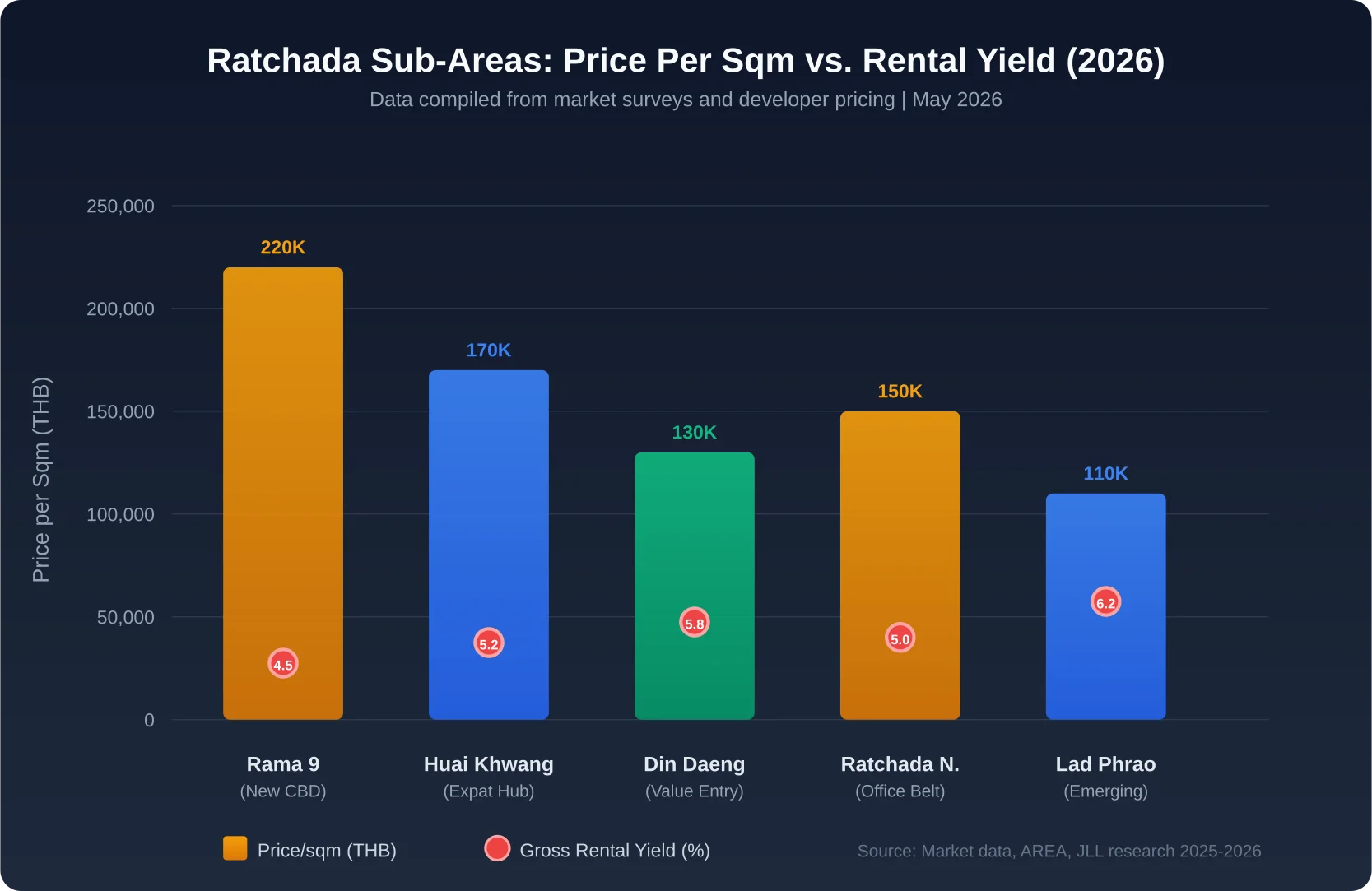
1. Rama 9 — The New CBD Core
MRT stations: Phra Ram 9, Rama 9
Price range: ฿180,000–250,000/sqm
Typical 1BR price: ฿4.5–6.5 million
Gross rental yield: 4.3–4.8%
Rama 9 is the premium end of Ratchada. If you're the type of investor who wants capital growth potential comparable to Sukhumvit but at a 30–40% discount, this is your target.
The area around G Land and The 9th Towers has essentially become a satellite CBD. Corporate tenants — Japanese, Korean, and increasingly Chinese professionals working at nearby headquarters — drive consistent rental demand. Occupancy rates in well-managed buildings here run 85–92%.
Best for: Investors with ฿5M+ budgets seeking long-term capital appreciation in a transitioning neighborhood.
What most people get wrong: They assume Rama 9 prices already reflect its "New CBD" status. They don't. At ฿200,000/sqm average, Rama 9 still trades at roughly a 35% discount to comparable Sukhumvit properties at Grade A locations. The re-rating is still in progress.
2. Huai Khwang — The Expat Rental Hub
MRT stations: Huai Khwang, Thailand Cultural Centre
Price range: ฿140,000–200,000/sqm
Typical 1BR price: ฿3.0–5.0 million
Gross rental yield: 5.0–5.5%
Huai Khwang is the workhorse of Ratchada investment. The neighbourhood has the highest concentration of expat-occupied rental units in the corridor, thanks to its proximity to both the Rama 9 office cluster and the Huai Khwang night market area that draws younger foreign residents.
Chinese buyers dominate new purchases here — I've seen buildings where 70%+ of foreign quota is taken by mainland Chinese investors. This creates both opportunity (strong rental demand from Chinese expats) and risk (quota saturation, homogeneous buyer base).
Best for: Yield-focused investors with ฿3–5M budgets who prioritize rental income over capital growth.
3. Din Daeng — The Value Entry Point
MRT stations: Sutthisan, Lat Phrao (south)
Price range: ฿100,000–150,000/sqm
Typical 1BR price: ฿2.0–3.5 million
Gross rental yield: 5.5–6.2%
Din Daeng offers the highest yields in the Ratchada corridor and the lowest entry prices. It's also the most "in-transition" area — pockets of older shophouses sit alongside new mid-rise condos. The upcoming MRT Orange Line, which will connect Din Daeng to Bang Kapi and Min Buri, is the catalyst that could re-rate this sub-area significantly.
I've walked Sutthisan Road dozens of times over the years. The transformation between 2018 and 2026 is visible: new convenience stores, refurbished commercial spaces, and a noticeable increase in foreign foot traffic. But it's still uneven — building selection matters enormously here.
Best for: Budget-conscious investors (฿2–3.5M) willing to accept a less polished neighborhood in exchange for higher yields and Orange Line upside.
4. Ratchadaphisek North — The Entertainment & Office Belt
MRT stations: Ratchadaphisek, Lat Phrao
Price range: ฿120,000–170,000/sqm
Typical 1BR price: ฿2.8–4.5 million
Gross rental yield: 4.8–5.2%
The northern stretch of Ratchadaphisek Road is defined by its entertainment venues (Show DC, Siam Niramit area), government offices, and the Esplanade shopping complex. It's a practical, mid-market zone that attracts Thai civil servants and mid-level professionals alongside a modest expat community.
The MRT interchange at Lat Phrao (Blue Line meets future MRT extensions) makes this a connectivity play. Rental demand is steady rather than spectacular, but vacancy risk is low.
Best for: Conservative investors seeking stable 5% yields with lower volatility and moderate capital growth.
5. Lad Phrao — The Emerging Outer Zone
MRT stations: Phahon Yothin, Lat Phrao (interchange), Chatuchak
Price range: ฿85,000–120,000/sqm
Typical 1BR price: ฿1.8–3.0 million
Gross rental yield: 5.8–6.5%
Lad Phrao technically sits at the northern edge of the Ratchada-Lad Phrao zone defined in AREA's survey. It's the cheapest sub-area with the highest yields — and the most speculative. The Lat Phrao MRT interchange and proximity to Central Ladprao and Union Mall keep foot traffic high, but the area feels more "local Bangkok" than "international investment corridor."
My honest assessment: Lad Phrao works for investors who live in Bangkok and can self-manage. For overseas investors, the management overhead and relatively thin resale market make it a tougher proposition than Huai Khwang or Din Daeng.
Best for: Bangkok-based investors with local management capability seeking the highest possible yields at the lowest entry point.
Price Guide: What You'll Pay in Ratchada in 2026
📊 RATCHADA vs. OTHER BANGKOK AREAS — 2026 INVESTOR COMPARISON
Metric
Ratchada
Sukhumvit
CBD/Silom
Sathorn
Avg. Price/sqm
฿110K–220K
฿180K–350K
฿250K–450K
฿200K–380K
Gross Rental Yield
4.5–6.2%
4.0–5.5%
3.5–5.0%
4.0–5.0%
Foreign Buyer Share
80.3%
~40%
44.2%
~35%
Entry Price (1BR)
฿2.5–5M
฿4–10M
฿6–15M
฿5–12M
MRT Access
★★★★★
★★★★☆
★★★☆☆
★★★☆☆
Quota Risk
HIGH
Medium
Medium
Low-Med
5-Year Capital Growth
+15–25%
+10–20%
+8–15%
+8–18%
Sources: AREA survey 2025, JLL Research, CBRE Thailand, market data | Prices reflect Q1 2026 primary market
)
The table below summarizes current asking prices from developer inventories and secondary market listings across Ratchada sub-areas:
Sub-Area
Price/sqm Range
1BR (28-35 sqm)
2BR (50-65 sqm)
Price vs. Sukhumvit
Rama 9
฿180K–250K
฿4.5–6.5M
฿9–15M
-35% to -40%
Huai Khwang
฿140K–200K
฿3.0–5.0M
฿7–11M
-30% to -45%
Din Daeng
฿100K–150K
฿2.0–3.5M
฿5–8.5M
-45% to -55%
Ratchada North
฿120K–170K
฿2.8–4.5M
฿6–9.5M
-35% to -50%
Lad Phrao
฿85K–120K
฿1.8–3.0M
฿4.5–7M
-50% to -60%
Key insight: Across all sub-areas, Ratchada offers a 30–60% price discount to comparable Sukhumvit locations. This discount has been narrowing by roughly 2–3 percentage points per year since 2020, which is exactly what you'd expect as the New CBD narrative matures.
For foreign buyers specifically, the average purchase price in the Ratchada-Lad Phrao area was approximately ฿2.6 million per unit in 2025 — compared to ฿8.236 million in the CBD and roughly ฿5.5 million in Sukhumvit. This makes Ratchada the most accessible entry point for foreign condominium investment in central Bangkok.
Rental Yields and Tenant Demand in Ratchada
Average Yields by Sub-Area and Unit Type
Based on my analysis of transaction data and rental comparables:
Sub-Area
Studio Yield
1BR Yield
2BR Yield
Typical Monthly Rent (1BR)
Rama 9
4.5–5.0%
4.3–4.8%
3.8–4.5%
฿16,000–22,000
Huai Khwang
5.2–5.8%
5.0–5.5%
4.5–5.0%
฿14,000–20,000
Din Daeng
5.8–6.5%
5.5–6.2%
5.0–5.5%
฿10,000–16,000
Ratchada North
5.0–5.5%
4.8–5.2%
4.3–4.8%
฿12,000–18,000
Lad Phrao
6.0–6.8%
5.8–6.5%
5.2–5.8%
฿9,000–14,000
A clear pattern emerges: the further from Rama 9 you go, the higher the yield but the lower the absolute rent. This is classic Bangkok — yield and capital growth tend to move inversely.
Who Rents in Ratchada
Understanding your tenant base is crucial for vacancy management. The Ratchada rental market is driven by three distinct groups:
Corporate expatriates (Rama 9, Huai Khwang): Japanese, Korean, and Chinese professionals working at nearby office towers. Typically on 1–2 year corporate leases. They pay premium rents for well-maintained buildings with good facilities.
Young professionals and digital workers (Huai Khwang, Din Daeng): A growing cohort of Myanmar, Vietnamese, and Western remote workers attracted by MRT access and affordable rents. They prefer modern, compact units near stations.
Thai middle-class professionals (all areas): Government employees at local offices, corporate staff at Rama 9 towers, and retail managers. They provide a stable baseline of demand, particularly in the mid-range segment.
Long-Term vs. Short-Term Rental Strategy
In Bangkok, most residential condos cannot legally be rented for periods under 30 days without a hotel licence — which very few condominium buildings possess. This means long-term rentals (12+ months) are the dominant, legally compliant strategy for Ratchada investors.
Some investors attempt informal short-term letting via platforms, but this carries legal risk under the Hotel Act B.E. 2547 and can result in fines. I always advise clients to stick with long-term leases — the yields are predictable, the legal position is clear, and vacancy in Ratchada's MRT corridor is manageable.
The 49% Foreign Quota Problem — and How to Navigate It
This is the section most investment guides gloss over. In Ratchada, it's the single most important consideration for foreign buyers.
Why Ratchada's 80.3% Foreign Uptake Matters
The Condominium Act B.E. 2522 (as amended) limits foreign freehold ownership to 49% of the total unit area in a condominium building. The remaining 51% must be owned by Thai nationals.
When AREA reports that 80.3% of units sold in Ratchada-Lad Phrao went to foreigners, this does not mean 80.3% of the building is foreign-owned. It means 80.3% of units sold from developer inventory in 2025 were purchased by foreigners. However, this purchasing pattern is rapidly filling the 49% quota in popular buildings.
In buildings I've valued in Huai Khwang and Rama 9, foreign quota is already 85–95% consumed. Several developments have zero foreign quota remaining in their most desirable unit types.
What Happens When the Quota Is Full
When the 49% quota in a building is fully allocated, no additional foreign freehold purchases can be registered at the Land Department. Your options at that point are:
Leasehold: Register a 30-year lease (renewable for two additional 30-year periods under some structures). You get exclusive possession but not ownership.
Find another building: Plenty of newer developments still have quota available, particularly in Din Daeng and Lad Phrao.
Buy via Thai company: I strongly advise against this. The Land Department scrutinizes nominee structures, and the legal risk is significant.

How to Check Quota Availability Before You Buy
Before committing to any Ratchada condominium:
Ask the developer or managing agent for the current foreign quota allocation letter
Request the Juristic Person Office (สำนักงานนิติบุคคล) to confirm remaining foreign quota
Instruct your lawyer to verify quota status at the Land Department as part of due diligence
Check the Chanote — if purchasing on the secondary market, ensure the seller's unit is registered as foreign freehold and that the building still has quota headroom
What most people get wrong: They assume that because a building is new and has many units, the foreign quota must be available. In Ratchada, foreign demand is so concentrated that quota can be exhausted within months of a project's launch.
Infrastructure Pipeline: What's Coming to Ratchada in 2026-2028
Infrastructure spending is the single most reliable predictor of property value growth in Bangkok. Here's what's in the pipeline for the Ratchada corridor:
MRT Orange Line Impact
The MRT Orange Line (Taling Chan–Min Buri) will create a critical east-west axis through the Ratchada corridor. The section through Din Daeng and Huai Khwang is expected to begin trial operations in 2027–2028. Once operational, it will:
Connect Ratchada directly to Bang Kapi, Ramkhamhaeng, and Min Buri
Create an interchange with the Blue Line at two points within the corridor
Add approximately 15–20% to property values within 500m of new stations, based on MRT Blue Line precedent
New Office and Mixed-Use Developments
Several major projects are under construction or in planning:
G Land 2 (Rama 9): Second phase of the Grade A office complex, expected completion 2027
Mixed-use developments along Ratchadaphisek Road: At least three major projects are in the planning pipeline, combining retail, office, and residential components
Central Rama 9 expansion: Additional retail and lifestyle facilities extending the mall's footprint
Expressway and Road Improvements
The Sirat Expressway extension and improvements to the Ratchadaphisek–Din Daeng connector road are reducing travel times to Don Mueang Airport and the Eastern Economic Corridor. For rental demand, airport accessibility matters — it's a key factor for the growing Chinese and Japanese corporate tenant base.
Step-by-Step: Buying a Condo in Ratchada as a Foreigner
Legal Requirements and Documentation
To purchase a condominium in Thailand as a foreign national, you need:
Valid passport with a non-immigrant visa (or proof of eligibility)
Funds transferred from overseas in foreign currency (for the purchase amount)
Foreign Exchange Transaction form (FET) or Thor Tor 3, issued by the receiving Thai bank, confirming the inward remittance
The building must have available foreign quota (under 49% of total unit area)
No outstanding overstay or immigration issues
The Purchase Process
Select a property — verify foreign quota availability with the developer or juristic office
Sign the Reservation Agreement and pay the booking fee (typically ฿50,000–100,000)
Engage a Thai lawyer to conduct due diligence (title search, quota verification, developer financials)
Sign the Sale and Purchase Agreement (SPA) — typically within 15–30 days of reservation
Transfer funds from overseas — the full purchase price must be remitted in foreign currency and converted to Thai Baht in-country
Obtain the FET/Tor Tor 3 form from your Thai bank — this is essential for Land Department registration
Register the transfer at the Land Department — both buyer and seller (or their representatives) must attend
Receive the Chanote (title deed) — confirming your freehold ownership
Financing Options for Foreign Buyers
Most Thai banks do not offer mortgage lending to non-resident foreigners. The exceptions are:
Bangkok Bank and Kasikornbank occasionally offer loans to foreigners with work permits and Thai income — typically at 60–70% LTV
Developer financing — some developers offer instalment plans (2–3 years) at 0–5% interest
Overseas financing — using assets in your home country as collateral (through international banks)
In practice, the majority of foreign purchases in Ratchada are cash transactions. The relatively low entry prices (฿2–5 million for a 1BR) make this feasible for most international investors.
Tax Obligations and Ongoing Costs
Tax/Cost
Rate
Who Pays
Transfer fee
2% of appraised value
Typically shared 50/50
Specific Business Tax
3.3% of sale price (if sold within 5 years)
Seller
Stamp duty
0.5% of sale price (if SBT not applicable)
Seller
Withholding tax
Progressive (1–5% of appraised value)
Seller
Common area maintenance
฿40–80/sqm/month
Buyer (ongoing)
Sinking fund
฿300–600/sqm (one-time)
Buyer
As a buyer, your primary costs are the transfer fee (1% if shared), sinking fund, and ongoing CAM fees. Budget an additional 3–5% of the purchase price for all transaction costs.
Risks and Red Flags for Ratchada Investors
No investment analysis is complete without an honest assessment of downside risks. Here's what concerns me about the Ratchada corridor in 2026:
1. Oversupply in Huai Khwang and Din Daeng
The 2025 AREA survey covered nearly 2,000 condominium projects in Bangkok and surrounding areas. In the Ratchada corridor specifically, I estimate there are 15,000–20,000 condo units either recently completed or under construction. Not all will find tenants immediately. Buildings in Huai Khwang and Din Daeng are reporting 3–6 month vacancy periods for first-time rentals on new units.
Mitigation: Focus on established buildings with proven rental records rather than off-plan speculations. Buildings that are 3–5 years old with strong juristic management outperform brand-new buildings in the first 2 years.
2. Quota Saturation and Exit Liquidity Risk
If a building's foreign quota is full, you can only sell your unit to a Thai buyer or another foreign buyer who accepts a leasehold structure. This narrows your exit market and can compress resale prices by 5–10% relative to buildings with available quota.
Mitigation: Before buying, check not just current quota status but the trajectory — in a building that's 40% foreign-owned with strong foreign demand, you'll likely face quota saturation within 2–3 years.
3. Developer Reputation Due Diligence
The Ratchada corridor has attracted many mid-tier developers alongside the established names. I've valued buildings by developers who subsequently faced financial difficulties, leaving incomplete common areas and deferred maintenance.
The Thai Baht has fluctuated between 32–37 THB/USD over the past three years. A stronger Baht reduces your effective yield when repatriated; a weaker Baht enhances it. Thailand's GDP growth has moderated to 2.5–3.0% annually, and the Bank of Thailand's policy rate decisions directly affect financing costs and domestic demand.
Mitigation: For yield-focused investors, currency fluctuations are a long-term consideration rather than an immediate threat. Focus on properties with strong tenant demand fundamentals — these hold value regardless of macro conditions.
My Bottom Line for Ratchada Investors in 2026
Having watched this corridor evolve for over a decade, here's my candid assessment:
Ratchada offers the best risk-adjusted returns in central Bangkok for foreign investors with budgets of ฿2–6 million. No other corridor combines MRT connectivity, New CBD transformation potential, 4.5–6.2% yields, and a 30–50% price discount to Sukhumvit in a single package.
But — and this is critical — the window for hassle-free foreign freehold purchase is narrowing. As quota fills in the most desirable buildings, you'll face either higher prices (Rama 9) or leasehold alternatives. The time to act is now, not in 2027 when the Orange Line opens and re-prices the entire corridor.
Yes, foreigners can purchase condominium units in Ratchada under freehold ownership, subject to the 49% foreign quota per building. This means up to 49% of the total unit area in a condominium can be owned by foreign nationals. In the Ratchada-Lad Phrao area, demand is so high that this quota fills quickly in popular buildings — always verify availability before committing.
What is the average rental yield in Ratchada in 2026?
Average gross rental yields in Ratchada range from 4.3% in the Rama 9 sub-area (premium pricing, lower yield) to 6.5% in Lad Phrao (lower pricing, higher yield). The corridor average is approximately 5.0–5.5%, which compares favourably to Sukhumvit's 4.0–5.5% and the CBD's 3.5–5.0%.
Is Ratchada a good area for property investment?
Ratchada is one of the strongest investment corridors in Bangkok for 2026. It leads the city in foreign buyer volume (2,089 units to foreigners in 2025), benefits from the New CBD transformation around Rama 9, has full MRT Blue Line coverage, and offers entry prices 30–50% below Sukhumvit equivalents. Key risks include foreign quota saturation and oversupply in some sub-areas.
How much do I need to invest in a Ratchada condo?
Entry prices start from approximately ฿1.8 million for a studio or small 1BR near MRT Lat Phrao, up to ฿6.5 million for a premium 1BR near MRT Rama 9. Most foreign investors target the ฿2.5–5.0 million range for a well-located 1BR unit. Budget an additional 3–5% for transaction costs including transfer fees and sinking fund.
What happens when the foreign quota is full in a Ratchada building?
When the 49% foreign freehold quota is fully allocated, no further foreign freehold transfers can be registered. Your remaining options are: (1) purchase a leasehold interest (typically 30 years, renewable), (2) find a different building with available quota, or (3) in rare cases, wait for an existing foreign owner to sell, freeing up quota. Buying through a Thai company (nominee structure) is legally risky and not recommended. Always verify quota status before making an offer.
Former valuation director at Knight Frank Thailand with 12+ years analyzing Bangkok property markets. Specializes in investment analysis, market trends, and foreign ownership regulations. MBA from Thammasat University.