Best Areas to Live in Bangkok for Expats 2026: The Complete Neighborhood Guide
By Sommart Wongtrakul · May 11, 2026
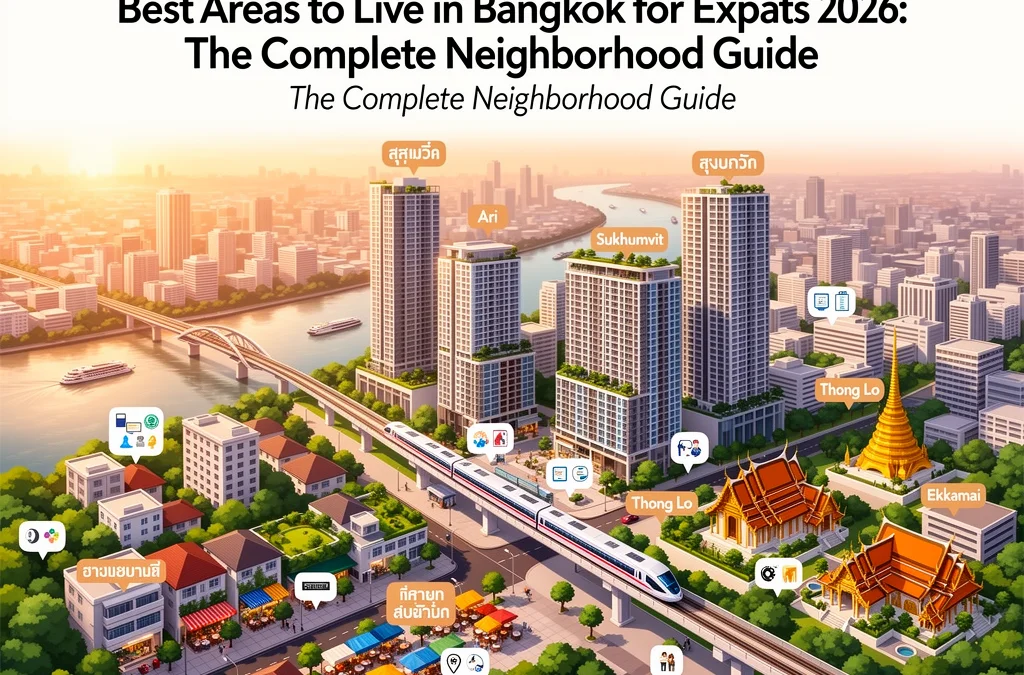
TL;DR: Bangkok's best expat neighborhoods in 2026 are Sukhumvit (convenience and international amenities), Silom/Sathorn (business professionals), Thonglor/Ekkamai (young professionals and nightlife), Riverside (luxury waterfront living), and Phrom Phong (family-friendly). Monthly rents range from ฿20,000 for studios to ฿120,000+ for luxury 3-bedrooms. Transportation access, international schools, and lifestyle amenities vary significantly by area—choose based on your priorities.
Bangkok continues to attract expatriates from around the globe, and 2026 shows no signs of slowing. With over 300,000 foreign residents calling this metropolis home, the Thai capital consistently ranks among the world's most desirable destinations for quality of life versus cost of living. As someone who has spent 12 years analyzing Bangkok's property market from my position as valuation director at Knight Frank Thailand, I've witnessed neighborhoods transform, prices fluctuate, and communities evolve. This guide distills that expertise into actionable insights for finding your perfect Bangkok neighborhood.
Understanding Bangkok's Expat in 2026
Why Bangkok Remains Asia's Top Expat Destination
The numbers tell a compelling story. According to the Bank of Thailand, foreign direct investment in real estate has remained robust through 2025, with Bangkok condo purchases by non-Thai nationals accounting for approximately 27% of all foreign acquisitions in the country [Source: Bank of Thailand, 2025]. The Thai government's long-term resident visa programs, including the Thailand Elite visa and recent amendments to retirement visa requirements, have made long-term settlement more accessible than ever.
What draws expats isn't just the relatively low cost of living—though a luxury lifestyle here costs roughly 40-50% less than comparable cities like Singapore or Hong Kong according to Numbeo's 2025 Cost of Living Comparison. It's the complete package: world-class healthcare (Bumrungrad and Bangkok Hospital rank among Asia's best), internationally accredited schools, exceptional culinary diversity, and a social infrastructure that welcomes foreign residents. The BTS Skytrain and MRT subway systems have expanded significantly, making car-free living feasible in ways that weren't possible even five years ago.
Key Factors That Define Expat-Friendly Neighborhoods
When evaluating where to live, experienced expats and I consistently weigh five factors:
- Public Transit Access: Properties within 500 meters of BTS or MRT stations command premiums of 15-25% but offer irreplaceable quality-of-life benefits
- International Amenities Density: supermarkets, restaurants, schools, and healthcare within walking distance
- Community Composition: areas with established expat populations offer easier onboarding and social networks
- Value Trajectory: understanding which neighborhoods are appreciating versus plateauing
- Practical Safety: flood history, crime statistics, and emergency service access
How to Use This Guide
I've organized this article to serve different reader profiles. If you're a family prioritizing school access, jump to the family recommendations. If you're relocating for work in the CBD, the Silom/Sathorn section offers the most relevant insights. Budget-conscious readers should focus on the emerging areas section, which reveals neighborhoods offering 30-40% savings with minimal lifestyle compromises.
The Big 5: Bangkok's Premier Expat Neighborhoods
Sukhumvit: Bangkok's Expat Central
Sukhumvit Road is Bangkok's longest and most important thoroughfare, stretching over 100 kilometers from the city center to the eastern provinces. For expats, the "Sukhumvit" that matters runs roughly from Soi 1 to Soi 71, served by the BTS Skytrain's Sukhumvit Line.
Why Expats Choose Sukhumvit
The evidence is in the demographics. Estimates suggest 60-70% of Bangkok's Western expat population lives along this corridor. Nana and Asok (Sukhumvit Soi 4 and 21) anchor the neighborhood's entertainment and business districts, while Phrom Phong (Soi 39-71) has evolved into the family-friendly segment with the Emporium and EmQuartier shopping complexes.
The area offers unparalleled convenience. Terminal 21 at Asok connects BTS and MRT lines and houses everything from an international food court to a cinema. Major international schools including NIST International School and St. Andrews International School are within easy reach. Healthcare access is exceptional—Bumrungrad Hospital, the gold standard for medical tourism in Southeast Asia, sits directly on Sukhumvit.
What You'll Pay in 2026
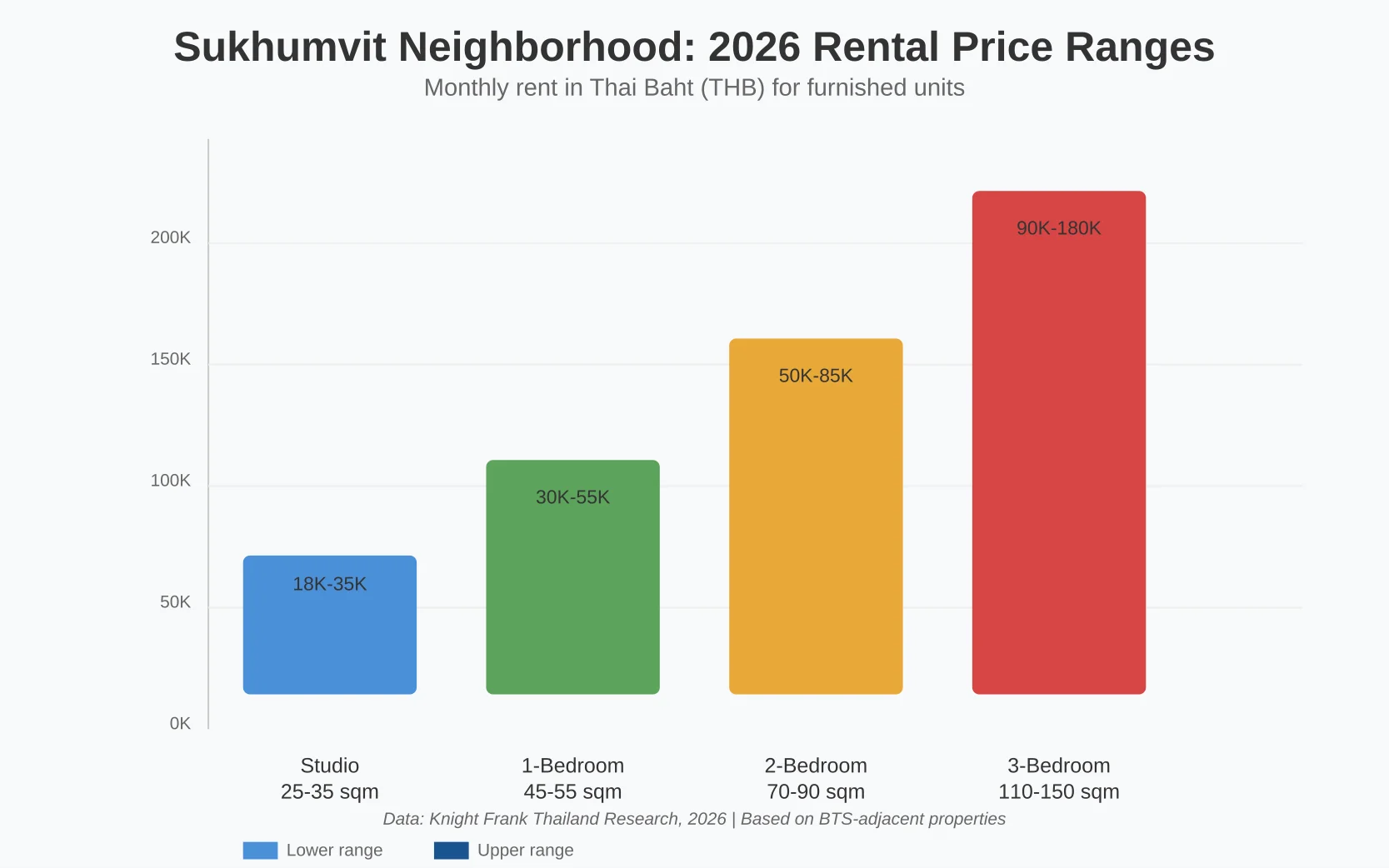
- Studio condos (25-35 sqm): ฿18,000-35,000/month
- 1-bedroom units (45-55 sqm): ฿30,000-55,000/month
- 2-bedroom condos (70-90 sqm): ฿50,000-85,000/month
- 3-bedroom luxury units (110-150 sqm): ฿90,000-180,000/month
Prices have stabilized after 8-12% annual increases during 2022-2024, with 2025-2026 showing more modest 3-5% growth. BTS-adjacent properties still command the premium, but secondary locations 10-15 minutes' walk from stations offer better value.
My Assessment: Sukhumvit remains the default choice for good reason—it's genuinely convenient, offers the most lifestyle options, and maintains strong rental demand. The trade-off is density and noise. If you value tranquility, look at the quieter sois (side streets) or consider adjacent neighborhoods.
Silom and Sathorn: The Business Hub
Silom and Sathorn form Bangkok's central business district, home to Thai financial institutions, multinational corporate headquarters, and the stock exchange. For expats working in banking, finance, law, or consulting, this is ground zero.
Why Expats Choose Silom/Sathorn
Proximity to work remains the primary driver. The MRT Blue Line serves Silom with stations at Silom, Chong Nonsi, and Saint Louis, while the BTS Saladaeng station connects to the Sukhumvit Line. The area offers a different character than Sukhumvit—more glass towers, more office workers, and a more pronounced international business atmosphere.
Lumpini Park provides 58 acres of green space in the middle of the CBD, a genuine urban oasis. Morning tai chi sessions and evening jogs around the lake are beloved rituals for local and expat residents alike. The Sala Daeng area offers excellent nightlife and dining, while Patpong Night Market remains infamous (though gentrifying).
Sathorn is increasingly residential, particularly the stretch between Chong Nonsi and Surasak stations. The area attracts professionals who prioritize commute convenience and appreciate the mature infrastructure.
What You'll Pay in 2026
- Studio condos (28-38 sqm): ฿22,000-40,000/month
- 1-bedroom units (45-60 sqm): ฿35,000-65,000/month
- 2-bedroom condos (70-95 sqm): ฿55,000-95,000/month
- 3-bedroom luxury units (110-160 sqm): ฿100,000-200,000/month
Premium Sathorn locations near BTS stations can exceed these ranges by 20-30%. The market here is driven heavily by corporate leasing, which means quality is consistently high but deals are less negotiable than in residential-focused neighborhoods.
My Assessment: Silom/Sathorn wins on commute convenience if you work in the CBD. The trade-offs are higher prices and less neighborhood character. Young professionals often prefer living on Sukhumvit and commuting to Sathorn—the 10-minute BTS ride costs ฿30 and offers more lifestyle variety.
Thonglor and Ekkamai: The Creative District
Thonglor (Soi Sukhumvit 55) and Ekkamai (Soi Sukhumvit 63) represent Bangkok's trendiest expat neighborhoods. This is where creatives, entrepreneurs, digital nomads, and young professionals gravitate—particularly those in tech, design, marketing, and entertainment industries.
Why Expats Choose Thonglor/Ekkamai
The lifestyle offering is unmatched for a certain demographic. These adjacent sois form a continuous entertainment and dining corridor featuring craft coffee roasters, boutique gyms, co-working spaces, rooftop bars, and restaurants spanning Thai street food to European fine dining. Soi Think (Park Lane Ekkamai) and The Mansion (Ekkamai 17) represent the new generation of residential development—modern buildings with genuine design sensibility.
The expat community here skews younger—30s and early 40s—than Sukhumvit's broader demographic. Social scenes revolve around the neighborhood's restaurants, bars, and clubs rather than expatriate organizations or formal community events.
What You'll Pay in 2026
- Studio condos (30-40 sqm): ฿25,000-45,000/month
- 1-bedroom units (50-60 sqm): ฿40,000-70,000/month
- 2-bedroom condos (75-100 sqm): ฿65,000-110,000/month
- 3-bedroom luxury units (120-160 sqm): ฿120,000-220,000/month
Thonglor commands a premium over Ekkamai—expect to pay 15-25% more for equivalent properties in Thonglor proper versus Ekkamai's quieter sois.
My Assessment: Thonglor/Ekkamai suits single professionals and couples without children who prioritize nightlife, dining, and social scene. Families find the area less practical—schools and family amenities are more dispersed, and prices reflect the premium positioning. For those who fit the demographic, it's Bangkok's most enjoyable neighborhood.
Riverside: Luxury Living Along the Chao Phraya
The Riverside corridor encompasses the Thonburi (west bank) side of the Chao Phraya River from Rama III Bridge south to Rama IX Bridge, plus select locations on the eastern bank near Sathorn.
Why Expats Choose Riverside
Space and scenery define the appeal. Riverside developments offer larger units than central Bangkok—true 3-bedroom apartments with 150+ square meters, rooftop terraces, and genuinely impressive river views. The lifestyle is more relaxed, more residential, and more "holiday" in character.
IconSiam, Southeast Asia's largest luxury mall, anchors the northern end of the riverfront with direct river access via ferry. The BTS extension to Bang Wa station (connecting to the Silom Line) has improved accessibility significantly, though a car or motorbike taxi remains essential for daily logistics.
International schools in the area include Invictus British International School and St. Joseph's Bang Na. Several major hospitals serve the district.
What You'll Pay in 2026
- 2-bedroom river-view units (90-120 sqm): ฿55,000-90,000/month
- 3-bedroom luxury units (140-200 sqm): ฿90,000-180,000/month
- 4-bedroom penthouses (250-400 sqm): ฿180,000-400,000/month
My Assessment: Riverside appeals to families seeking space and quality, retirees drawn to waterfront living, and anyone prioritizing indoor square footage over transit access. The trade-off is dependency on personal transportation. If you're working in the CBD, expect 30-45 minute commutes during peak hours.
Lumpini: The Green Oasis
Lumpini occupies prime real estate between Silom and Rama IV Road, anchored by the park of the same name. This area attracts expats seeking central location without Silom's purely commercial character.
Why Expats Choose Lumpini
The park is everything. The 58-acre Lumpini Park offers morning and evening activities that define the expat experience—organized running groups, outdoor yoga, tai chi, and swimming in the lake. Residents describe the neighborhood as having genuine community cohesion that many central Bangkok areas lack.
The MRT Blue Line serves the area at Lumphini and Si Lom stations, while the upcoming MRT Orange Line will add access at Rama IV. The proximity to Sala Daeng's dining and Silom's business district is genuinely walkable.
Condo options skew toward mid-size developments built in the 2000s-2010s—buildings like Lumpini Tower and Park Place offer solid quality at moderate prices.
What You'll Pay in 2026
- Studio condos (30-38 sqm): ฿20,000-35,000/month
- 1-bedroom units (45-58 sqm): ฿32,000-55,000/month
- 2-bedroom condos (70-95 sqm): ฿50,000-85,000/month
- 3-bedroom units (110-140 sqm): ฿80,000-140,000/month
My Assessment: Lumpini offers the best balance of central location, green space, and moderate pricing in central Bangkok. It's under-appreciated compared to Sukhumvit and Silom, likely because development has been more incremental and less dramatic. For families and anyone valuing walkability and outdoor activities, it deserves serious consideration.
Budget Breakdown: What to Expect to Pay in 2026
Understanding rental costs requires distinguishing between location tiers and property types. Based on my analysis of current market data from Knight Frank Thailand research and comparable transactions, here's what you should budget:
Studio and 1-Bedroom Condos
The bread and butter of Bangkok expat rentals. Studios (25-40 sqm) typically serve singles or couples, while 1-bedrooms (45-65 sqm) offer genuine living space.
| Location | Studio (25-40 sqm) | 1-Bedroom (45-65 sqm) |
|---|---|---|
| Sukhumvit (Nana-Asok) | ฿22,000-38,000 | ฿35,000-55,000 |
| Sukhumvit (Phrom Phong) | ฿25,000-42,000 | ฿38,000-60,000 |
| Thonglor/Ekkamai | ฿28,000-48,000 | ฿42,000-70,000 |
| Silom/Sathorn | ฿24,000-42,000 | ฿38,000-65,000 |
| Lumpini | ฿20,000-35,000 | ฿32,000-55,000 |
| Riverside | ฿18,000-30,000 | ฿28,000-48,000 |
2-Bedroom Family Homes
Two-bedroom condos represent the sweet spot for couples and small families. At 70-100 sqm, these units offer genuine separation between living areas and bedrooms.
Budget ฿50,000-95,000/month for quality 2-bedrooms in central locations. Premium buildings in Thonglor and Sathorn regularly exceed ฿100,000. Riverside offers better value per square meter but requires transportation trade-offs.
3-Bedroom Luxury Units
Large family units or premium executive apartments command significant premiums. At 110-180 sqm, these are true luxury properties.
Central Bangkok (Sukhumvit, Sathorn, Thonglor): ฿90,000-220,000/month
Riverside: ฿80,000-180,000/month
Outer areas: ฿60,000-120,000/month
Utilities and Living Expenses
Beyond rent, monthly costs to budget:
- Electricity: ฿3,000-8,000 (air conditioning is the major driver)
- Water: ฿500-1,500
- Internet (fiber): ฿600-1,200
- Condo maintenance fees: ฿25-60/sqm/month (typically ฿2,000-6,000)
- Property tax (for leaseholders, minimal): included in rent typically
What Most People Get Wrong: First-time Bangkok renters often underestimate utility costs. Tropical heat means air conditioning running 12-18 hours daily. A well-insulated modern building can reduce electricity bills by 30-40% compared to older constructions—factor this when comparing seemingly equivalent properties.
Transportation: Getting Around from Each Area
BTS Skytrain Coverage
The BTS system operates two lines through expat areas:
Sukhumvit Line: Runs north-south through Sukhumvit, serving Nana, Asok, Phrom Phong, Thonglor, Ekkamai, Phra Khanong, On Nut, and Bang Chak. This line is the backbone of expat Bangkok.
Silom Line: Connects Saphan Taksin (River City, gateway to Riverside ferry) through Silom, Sala Daeng, and Lumpini to the National Stadium and beyond.
Monthly BTS passes cost ฿1,445 for unlimited rides—excellent value if you commute daily.
MRT Subway Access
The MRT system (Blue, Purple, Yellow, Pink, Gold, and new Orange Line) provides different coverage:
- Blue Line: Serves Silom directly
- Purple Line: Southern corridor to Nonthaburi
- Yellow Line: Connects Thammasat University to Samrong (via Thonglor/Ekkamai area)
- Orange Line: Will connect Hua Lamphong to Bang Chan (currently under construction)
BTS and MRT are separate systems requiring different cards/tokens. Asok (Terminal 21) and Silom stations offer transfers.
Commute Times to Key Destinations
From Phrom Phong (Sukhumvit 39):
- To Silom/Sathorn CBD: 15 minutes BTS
- To Lumpini Park: 20 minutes BTS
- To RCA entertainment district: 25 minutes BTS
From Thonglor (Sukhumvit 55):
- To Silom/Sathorn CBD: 12 minutes BTS
- To Emporium: 5 minutes BTS
- To Rama III offices: 30 minutes taxi (off-peak)
From Riverside (near IconSiam):
- To Silom CBD: 25 minutes (taxi/river ferry combination)
- To Sukhumvit: 35 minutes taxi
Taxis, Grab, and Motorbike Reality
Bangkok's taxi system is metered (starting fare ฿35) and generally reliable. Grab (Southeast Asia's Uber equivalent) operates widely with transparent pricing. Motorbike taxis offer fastest point-to-point travel in heavy traffic—a necessity rather than a lifestyle choice.
The Honest Truth: Transit proximity should weigh heavily in your location decision. Traffic in Bangkok is genuinely terrible. A 5-kilometer journey can take 15 minutes at 11 PM or 1.5 hours during rush hour (7-9 AM, 5-8 PM). Properties within 500 meters of BTS or MRT stations offer irreplaceable quality-of-life benefits.
Family vs. Single Expats: Area Recommendations
Best Neighborhoods for Families with Children
Families should prioritize international schools, parks, and family-oriented amenities:
Phrom Phong (Sukhumvit 39-71)
- NIST International School (walkable from most condos)
- St. Andrews International School nearby
- EmQuartier family amenities
- The area has lower density than Thonglor with more family-oriented restaurants and services
Riverside (near IconSiam)
- Invictus British International School
- St. Joseph's Bang Na
- More space per dollar
- Better air quality than central Sukhumvit
Bang Na
- Singapore International School
- More affordable family housing
- Growing expat community
- Requires car or BTS commute to CBD
Sathorn (Western side)
- St. Louis School (established Thai-international)
- Closer to Lumpini Park
- Good balance of access and price
Best Areas for Young Professionals and Singles
Thonglor/Ekkamai
- Social scene is unmatched
- Coworking spaces abundant
- Best dining and nightlife
- Premium pricing but energetic lifestyle
Nana/Asok (Lower Sukhumvit)
- Maximum convenience
- Nightlife options
- Good transit connections
- More diverse/chaotic environment
Sala Daeng
- Great balance of work and play
- Proximity to Lumpini Park
- Strong dining scene
- Quieter than Nana
Retirement Considerations
Retirees often prioritize different factors: healthcare access, tranquility, walkability, and community.
Lumpini: Excellent for active retirees. The park provides daily activity options. Central location means everything is accessible. Strong expat community of all ages.
Phrom Phong: Quieter than Thonglor but still energetic. Good healthcare at Samitivej Hospital. Established residential character.
Sathorn (Southern): Quieter residential sois away from the main roads. Good value in older, well-maintained buildings. Proximity to Lumpini Park.
Emerging Areas: Where Expats Are Moving in 2026
Bang Na and Outer Sukhumvit
Bang Na represents the frontier of expat Bangkok. The BTS extension has opened areas 20+ kilometers from central Sukhumvit to reasonable commute times. IKEA Bangkok and BITEC Exhibition Center anchor the area, with increasingly sophisticated residential and commercial development.
Why Consider: 40-50% lower rents than central Sukhumvit. New developments offer modern facilities. International schools including Concordian International School and Singapore International School Bangkok serve the area.
Trade-offs: 45-60 minute BTS commute to CBD. Limited nightlife and dining compared to established areas. Car dependency for daily logistics.
What You'll Pay: Studios ฿12,000-20,000/month, 2-bedrooms ฿28,000-45,000/month
Ramkhamhaeng and Minburi Corridor
This eastern corridor is seeing rapid development as central Bangkok prices push residents outward. Ramkhamhaeng University area has long attracted students and budget-conscious residents, but new MRT extensions are transforming the area's appeal.
Why Consider: Very affordable. MRT Blue Line extension is improving connectivity. Good local street food and markets.
Trade-offs: Less English-friendly than Sukhumvit. Limited international schools and healthcare. Still developing infrastructure.
What You'll Pay: Studios ฿10,000-18,000/month, 2-bedrooms ฿22,000-38,000/month
Phra Khanong and On Nut Revival
These intermediate neighborhoods—between established Sukhumvit and emerging Bang Na—offer middle ground positioning. On Nut's Tesco Lotus and surrounding residential complexes have created a self-contained expat ecosystem.
Why Consider: BTS access to CBD in 20-25 minutes. Significantly lower rents than Thonglor or Phrom Phong. Fully serviced by BTS. Good local amenities.
Trade-offs: Less trendy than Thonglor. Quieter nightlife. Street food focus rather than international restaurants.
What You'll Pay: Studios ฿15,000-25,000/month, 2-bedrooms ฿30,000-50,000/month
My Assessment: The Bangkok property market is rationalizing. Central locations have reached price ceilings while outer areas offer genuine value. For expats with flexible work arrangements (remote work, flexible hours, or company cars), these emerging areas deserve serious consideration.
📊 Bangkok Expat Cost Index 2026
Practical Steps: Securing Your Bangkok Home
Understanding Thai Lease Agreements
Thai residential leases typically run 1-3 years, with 1-year leases being standard. Key points:
Standard Terms:
- 1-year lease with 1-month deposit and 1-month advance rent
- Annual rental increases of 3-5% typical for renewals
- Landlord responsible for structural maintenance; tenant for general upkeep
- No-fee arrangement is standard (agents are paid by landlords)
What to Negotiate:
- Rent price (especially for multi-year commitments)
- Included utilities (some landlords offer all-inclusive)
- Furniture packages
- Early termination clauses
- Pet policies (enforced more strictly than Western markets)
Foreign Ownership Regulations
Foreign nationals face specific restrictions according to the Condominium Act B.E. 2522:
Condominiums: Foreigners can own up to 49% of total unit space in any condo building. Individual foreigners can own units in their own name (passport serves as identification). Payment typically in Thai Baht via transfer from foreign account.
Houses/Land: Foreigners cannot own land directly. Options include:
- Leasehold (30-year renewable)
- Thai nominee arrangements (legal but complex—consult a lawyer)
- Company structures (consult legal counsel)
My Recommendation: Stick to condos. The 49% foreign quota is rarely exhausted in popular buildings, and the legal clarity is worth the tradeoff.
Working with Agents vs. Direct Rentals
Agents:
- Typically represent landlords, not tenants
- Often have better access to unlisted units
- English-speaking agents common in expat areas
- Commission paid by landlord (no direct cost to tenant)
Direct Rentals:
- Many buildings have in-house leasing
- Can negotiate more directly
- Requires Thai language ability or persistence
- May find better "insider" deals
My Recommendation: Use an agent for your first Bangkok rental. The market is opaque enough that professional representation is valuable. Once you understand the system and have preferences, direct rentals become more viable.
Essential Documents You'll Need
Prepare these before signing:
- Passport: Original plus copies
- Visa documentation: Tourist visa acceptable for viewing; work visa or retirement visa needed for formal lease
- Employment letter: Most landlords require proof of income or employment
- Bank reference: International banks in Bangkok can provide references
- Previous landlord reference: Helpful but not always required
Bangkok Neighborhood Summary: Quick Reference
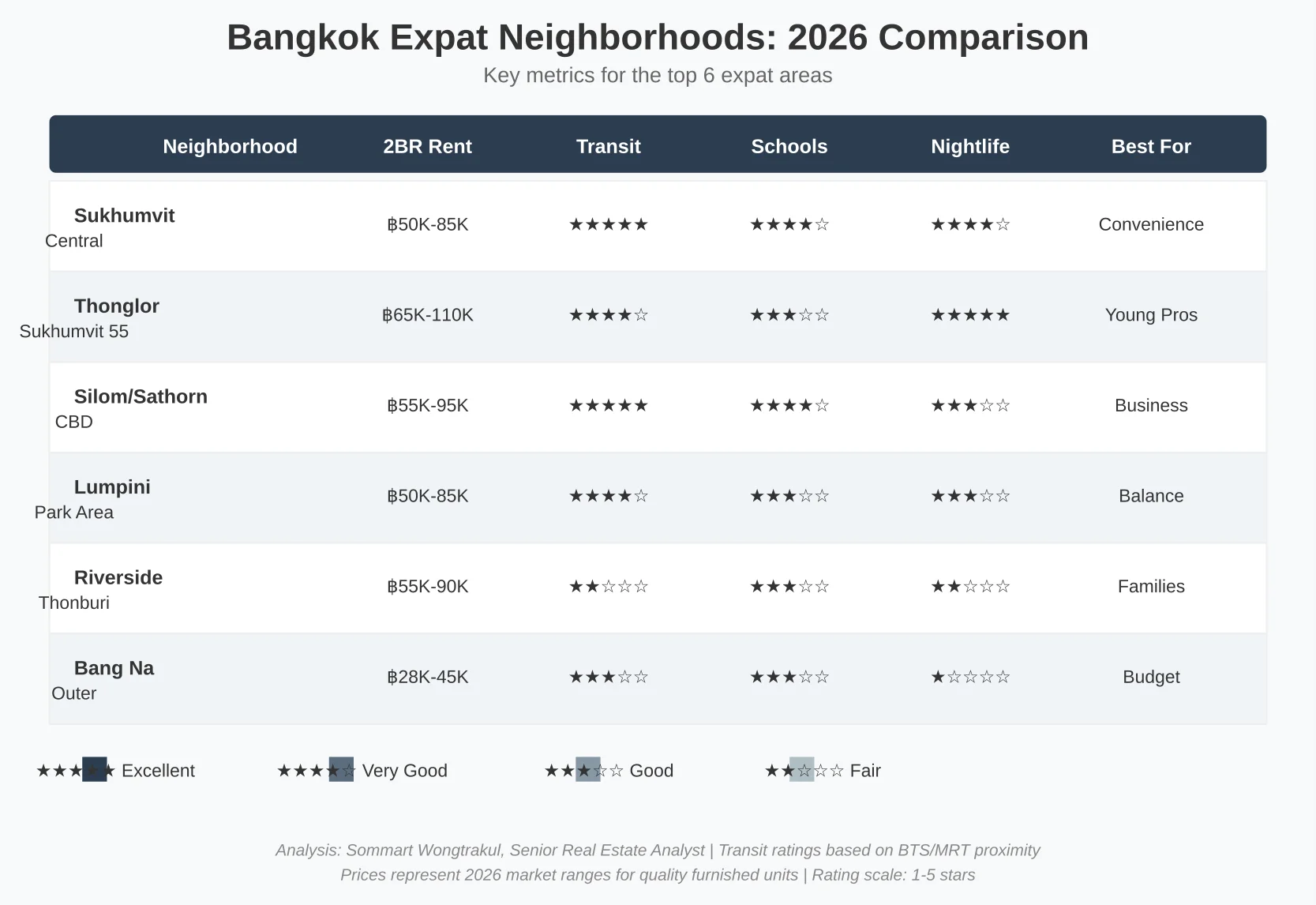
| Neighborhood | Best For | Monthly Budget (2BR) | Transit | Vibe |
|---|---|---|---|---|
| Sukhumvit (Central) | Convenience seekers | ฿50,000-85,000 | BTS direct | International, busy |
| Thonglor/Ekkamai | Young professionals | ฿65,000-110,000 | BTS + taxi | Trendy, social |
| Silom/Sathorn | Business commuters | ฿55,000-95,000 | MRT + BTS | Professional, central |
| Lumpini | Balance seekers | ฿50,000-85,000 | MRT + BTS | Green, community |
| Riverside | Families, space | ฿55,000-90,000 | Taxi + ferry | Relaxed, residential |
| Bang Na | Budget families | ฿28,000-45,000 | BTS extension | Developing, affordable |

Conclusion
Bangkok offers expats an exceptional quality of life at a fraction of the cost of comparable global cities. The key is matching your priorities—commute convenience, social scene, family needs, or budget constraints—to the right neighborhood.
For most first-time expats, I recommend Sukhumvit (specifically Phrom Phong or lower sois) as the optimal starting point. The area offers the most complete lifestyle package, the largest expat community for support, and excellent transit connections. As you learn the city and refine your preferences, you can always relocate.
The Bangkok of 2026 is more connected, more sophisticated, and more expat-friendly than ever. Whether you're coming for a two-year assignment or planning to stay indefinitely, the city has a neighborhood that fits.
Frequently Asked Questions
What is the average rent for a 1-bedroom condo in Bangkok's expat areas?
In central expat neighborhoods like Sukhumvit, Silom, and Thonglor, expect to pay ฿32,000-65,000/month for a quality 1-bedroom condo (45-60 sqm). Prices vary significantly by exact location, building quality, and proximity to BTS/MRT stations. Outer areas like On Nut or Bang Na offer 1-bedrooms starting at ฿20,000-28,000/month.
Is Sukhumvit good for families with children?
Yes, particularly the Phrom Phong area (Sukhumvit Soi 39-71). NIST International School is walkable from many condos, and the EmQuartier/Emporium area offers family-friendly amenities. The area has a more residential character than Thonglor, with good healthcare access at Samitivej Hospital.
How much does it cost to live in Bangkok as an expat?
Beyond rent, budget ฿15,000-30,000/month for food (mixing street food and restaurants), ฿3,000-8,000 for utilities, and ฿5,000-15,000 for transportation. A comfortable total budget for a single person is ฿60,000-100,000/month; couples should budget ฿90,000-150,000/month.
What areas should I avoid living in Bangkok?
Bangkok is generally safe, but some areas lack expat infrastructure or face practical challenges. Ratchada (away from MRT) offers good value but limited English. Deep outer suburbs may be affordable but create long commutes. Always view properties in person before committing, and ideally during both day and evening.
Can foreigners own property in Bangkok?
Foreigners can own condominiums outright (up to 49% of a building's total space). Houses and land require leasehold arrangements or company structures. Condo ownership is straightforward—your passport serves as identification, and ownership transfers are handled by the building's juristic person.
How do I find apartments in Bangkok?
Major online platforms include property listings for comprehensive rental searches. For personalized assistance, engage a local agent—professional representation helps navigate the opaque market. Walking neighborhoods and checking buildings directly also works, particularly in high-density areas like Bangkok condos zones.
What's the best way to commute in Bangkok?
The BTS Skytrain and MRT subway are the most reliable options during rush hour. A monthly pass (฿1,445) offers unlimited rides. Taxis are metered and affordable (starting ฿35). Grab provides transparent pricing. Motorbike taxis are fastest in traffic but weather-dependent.