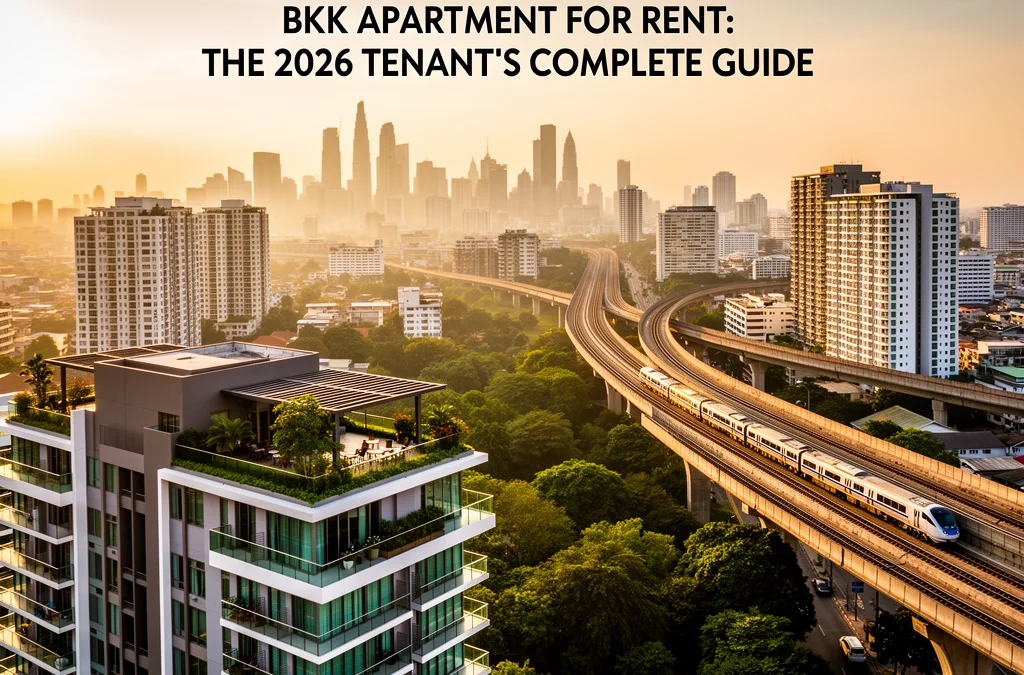
TL;DR — Searching for a Bkk apartment for rent means choosing between premium Sukhumvit tiers (THB 25,000–45,000/month for a 1-bed), mid-tier areas like On Nut and Phra Khanong (THB 12,000–18,000), and the new Yellow/Pink Line sub-markets (THB 8,000–14,000). With record condo oversupply in 2026, tenants can negotiate 5–15% off list prices. Foreigners need only a passport and valid visa to sign a 12-month lease.
Why This Guide Is Different
Most "Bkk apartment for rent" articles recycle the same neighbourhood lists and a price table copied from 2019. I'm Nattida Chen — a Bangkok-based property investment specialist and certified real-estate appraiser with 8+ years helping foreign tenants and landlords navigate Thai property law. What follows reflects the 2026 market, real numbers from the Real Estate Information Center (REIC), and tactics I use for clients every week.
If you want to start browsing listings while you read, our Bangkok real-estate platform shows live, verified inventory on a map, and the condos and apartments in Bangkok view lets you filter by station, price and size.
Bkk Apartment For Rent: The 2026 Market Snapshot
Why rents are softer in 2026
After the 2018–2022 condo boom, Greater Bangkok is now sitting on the largest unsold inventory in its history. According to the Real Estate Information Center (REIC), the number of unsold condominium units in Greater Bangkok passed 322,000 units at the end of Q3 2024 (Source: REIC, 2024). A large slice of these units are investor-owned and immediately available for rent the moment they're handed over.
For tenants this is the most important fact in the entire market: when supply outruns demand, list prices become starting points, not ceilings. Many landlords bought off-plan at 5–7% gross yield projections and now compete aggressively to keep units occupied, since an empty unit still owes the building its common-area fee every month.
What "apartment" actually means in Bangkok
This trips up nearly every newcomer. In Thailand the word "apartment" (อพาร์ตเมนต์) refers to a building under single ownership — one company or landlord owns the whole block and rents each unit directly. A "condominium" (คอนโดมิเนียม) is a building where units are owned individually under the Condominium Act B.E. 2522 (1979) and rented out by each owner.
This distinction has practical consequences for anyone hunting a Bkk apartment for rent:
| Feature | Apartment (single-owner) | Condominium (individually owned) |
|---|---|---|
| Lease counterparty | A company | An individual owner |
| Negotiation flexibility | Lower — corporate pricing | Higher — owner is motivated |
| Standard of units | Often uniform | Varies widely by owner |
| Deposit terms | Usually 1 month | Usually 2 months |
| Furniture | Usually fully furnished | Mixed (furnished / unfurnished) |
| Common-area fee | Built into rent | Paid separately, often by tenant |
Most expats and digital nomads actually end up in condos even when they search the word "apartment", because condos dominate the supply around BTS/MRT stations. I'll use "apartment" in the broad sense throughout this guide.
Rental Prices by BTS/MRT Corridor (2026)
In Bangkok, the BTS/MRT corridor matters far more than the postal district. Two buildings 800 metres apart can differ by 40% in rent purely because one is within walking distance of a station and the other isn't.
Below is the average monthly rent for a fully furnished 1-bedroom unit within ~600 metres of the station. The figures blend REIC's quarterly residential rental index with our own listing-sample data from H1 2026.
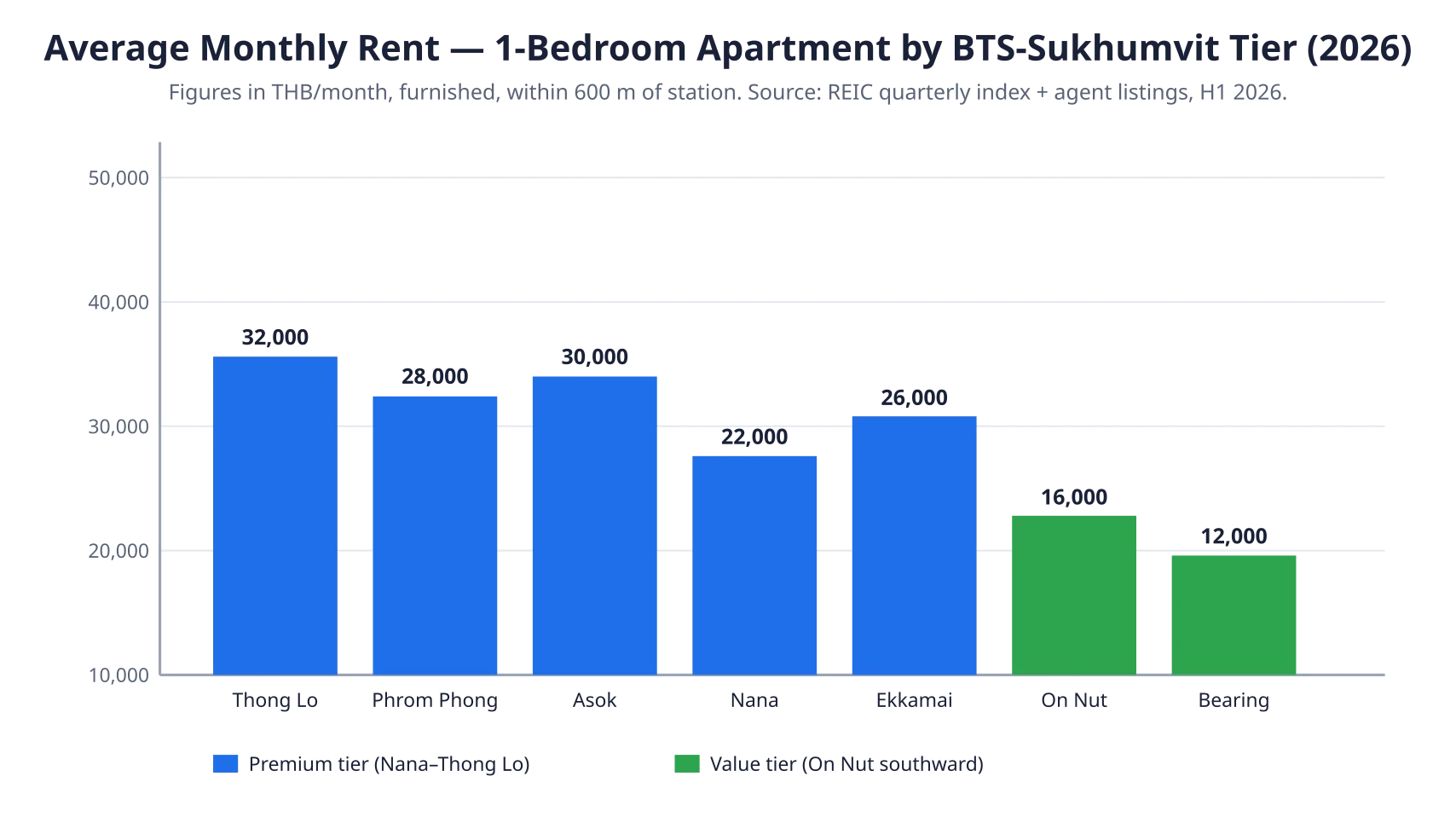
Sukhumvit BTS line (the spine of the expat rental market)
- Siam / Chit Lom — THB 30,000–50,000 for a 1-bed. Retail heart of Bangkok; limited residential supply keeps prices firm.
- Asok / Phrom Phong — THB 28,000–38,000. The classic premium tier, connected to the MRT at Asok.
- Thong Lo / Ekkamai — THB 26,000–35,000. Cafés, Japanese community, international schools nearby.
- On Nut / Phra Khanong — THB 12,000–18,000. The value sweet spot: still on the BTS, still central, but a single BTS stop south of the premium tier.
- Bearing / Samrong — THB 9,000–14,000. Samrong opened as the extension terminus and the area is still gentrifying fast.
Silom / Sathorn (the CBD)
- Sala Daeng / Chong Nonsi — THB 25,000–45,000 for a 1-bed. Walking distance to offices, premium pricing.
- Saint Louis / Yan Nawa — THB 18,000–28,000. Slightly quieter side streets, still walkable to the CBD.
New sub-markets opened up in 2024–2025
Two major rail openings reshaped the Bkk apartment for rent market and most guides still ignore them:
- Yellow Line (Lat Phrao – Samrong) — opened July 2023, fully connected through 2024–2025. Lat Phrao, Si Krupa, Hua Mak and Sri Udom now have walkable rail for the first time, opening up studios from THB 7,000–11,000/month.
- Pink Line (Khae Rai – Min Buri) — opened 2024–2025 across northern Bangkok. Mueang Thong Thani, Government Center and Ram Inthra areas have seen rental inventory surge.
These corridors are where budget-conscious tenants get the most station-adjacent value in 2026.
The True Monthly Cost of a Bkk Apartment For Rent
This is the gap that catches tenants off guard. The advertised rent is not your monthly outflow. Below is what to budget for a THB 20,000/month 1-bed condo.
| Cost item | Typical rate | Monthly estimate |
|---|---|---|
| Base rent (1-bed, mid-tier) | THB 18,000–22,000 | 20,000 |
| Common-area / maintenance fee | THB 45–70 / sqm / month | ~3,000 |
| Electricity (residential building tariff) | THB 7–8 / unit | ~1,800–2,500 |
| Electricity (government tariff, rare in condos) | THB 4–5 / unit | ~1,200–1,500 |
| Water | THB 17–22 / unit | ~150–300 |
| Internet (100–300 Mbps fibre) | THB 590–1,090 flat | ~800 |
| All-in monthly cost | ~25,800–26,600 |
That's 30% above the sticker price, and I'd say 15–25% is a realistic planning buffer across most Bangkok units.
What most people get wrong: they compare two listings purely on rent. A THB 18,000 unit at a government electric tariff (THB 4/unit) can be cheaper to live in than a THB 16,000 unit at a building tariff of THB 8/unit, once you add 3–4 months of usage. Always ask the agent "elek thang-tuai tao-rai?" — "what's the electricity rate?" — before signing.
What Foreigners Need to Rent: Documents and Legal Basics
Can a foreigner rent a Bkk apartment for rent? Yes — easily. Foreigners can lease any residential unit for residential use without a work permit. Here's what you actually need.
Required documents
- Passport (original + copy of photo page and the current visa/extension stamp).
- Valid visa or extension of stay — tourist, non-immigrant, retirement, education, all accepted.
- Some landlords ask for a work permit if you have one (it strengthens the application and helps the landlord with TM.30 reporting), but it is not legally required to sign a residential lease.
Lease structure and TM.30 reporting
Every time a foreigner stays at a property, the landlord is legally required to file a TM.30 report with Immigration within 24 hours (Source: Royal Thai Police Immigration Bureau). This is the landlord's responsibility, not yours — but make sure it actually happens, because an unfiled TM.30 can cause problems the next time you try to extend a visa or do a 90-day report. I include a TM.30 clause in every lease I draft for clients.
A standard Thai residential lease is 12 months, written in bilingual (Thai/English) form, and includes:
- Rental amount and due date (typically the 1st of each month).
- 2 months' security deposit + 1 month's rent in advance is the market norm (3 months total to move in).
- A list of furniture and fixtures with an inventory photo set.
- Early-termination terms (usually forfeiture of one month's deposit).
- Sub-letting is almost always prohibited.
Under the Civil and Commercial Code, Section 544 (Thailand), a lease of immovable property for more than three years must be registered at the Land Department to be enforceable beyond that term (Source: Ratchakitcha, Civil and Commercial Code). The vast majority of residential leases are 12 months and therefore need no registration.
Tenant rights and deposit return
Thai law does not impose a statutory timetable for deposit return, so your lease is the contract that matters. Insist on a written, dated inventory with photos at move-in and move-out — this is the single best protection against a landlord deducting for "damage" that was already there.
Negotiation Playbook: Pay Less Than the Asking Price
In 2026's oversupplied market, the asking price on a Bkk apartment for rent is genuinely negotiable. Here is the playbook I use for clients.
- Aim for 5–15% off list. Anything beyond 15% usually signals a distressed unit (poor floor, no view, construction noise next door) — investigate before celebrating.
- Offer a longer lease. A 24-month commitment often secures a 7–10% discount, because landlords love predictable income and avoid re-letting friction.
- Negotiate the deposit, not just the rent. Going from a 2-month deposit to a 1-month deposit frees up cash that matters more than THB 500/month off the rent.
- Ask for free add-ons. Free internet for 12 months, a free cleaning service, or furniture upgrades are cheaper for the landlord than a rent cut but worth real money to you.
- Pay quarterly or half-yearly in advance — many landlords will knock another 3–5% off for cash flow certainty.
Corporate lease vs personal lease
If you have a Thai-registered employer or your own company, you may be offered a corporate lease (the company is the tenant and pays the rent). This has tax implications: rental payments to individual landlords above THB 1,000/month are subject to 5% withholding tax that the company must deduct and remit (Source: Revenue Department, Revenue Code Section 40(8)). Corporate leases also give stronger deposit protection but are less flexible if you change jobs.
Case Study: On Nut vs Thong Lo — Real Tenant Search, H2 2025
To show how this all fits together, here's a real comparison I ran for a client — a single European marketing manager relocating to Bangkok on a 2-year contract. The brief: a furnished 1-bedroom, walkable to a BTS station, THB 30,000 all-in budget.
We compared two actual units: a 45 sqm 1-bed at a mid-rise condo 6 minutes' walk from On Nut BTS, asking THB 16,000/month, versus a 50 sqm 1-bed 4 minutes from Thong Lo BTS, asking THB 32,000/month.
Lessons Learned
- The "value" tier wasn't just cheaper — it was better value per baht. On Nut delivered THB ~384/sqm of usable space per month; Thong Lo came in at THB ~590/sqm. The premium for Thong Lo was a 53% premium per square metre.
- Negotiation worked in both directions. The On Nut landlord dropped from 16,000 to 14,500 (a 9.4% cut) because we offered a 24-month lease. The Thong Lo landlord moved from 32,000 to 29,500 (7.8%).
- Utilities swung the gap further. The On Nut building charged THB 7/unit on electricity; the Thong Lo unit was at THB 8.5/unit (a common mark-up in newer premium buildings). Over a year that's another THB 3,000–4,000 difference.
- The walk-to-station minutes matter for resale-of-lease value. When the client eventually sub-let, the Thong Lo unit re-let in 11 days; the On Nut unit took 23 days. Walkability is a liquidity factor too.
The client chose On Nut, kept THB ~15,000/month of headroom in the budget, and used the saving to fund weekend travel — exactly the lifestyle trade most Bangkok renters should consciously make.
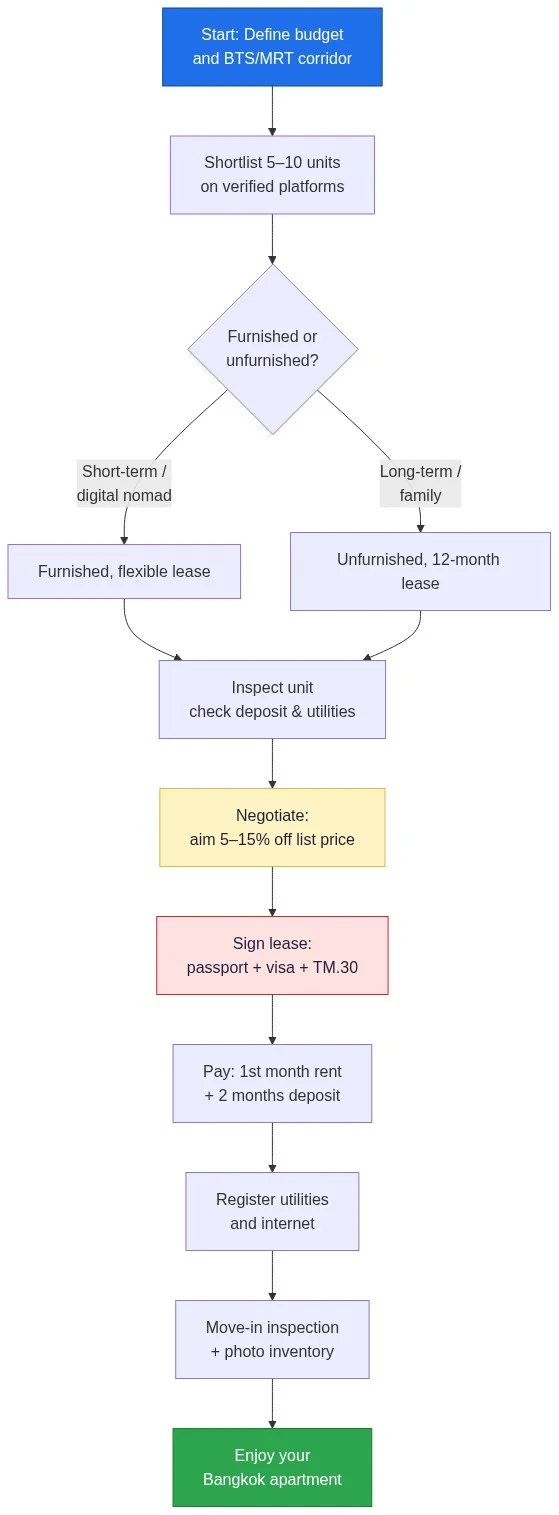
The Rental Process, Step by Step
Here's the full flow, from setting your budget to collecting the keys.
How to Search Efficiently (and Avoid Scams)
Verified search habits
- Filter by station, not by district. Bangkok postal districts (khet) are huge and span wildly different micro-markets. Filter by "within 600 m of [BTS station]" instead.
- Use map-based search. A walkable radius around a station is the single most reliable filter. The Bangkok property listings map lets you drop a pin and filter by rent, size, and bedrooms.
- Cross-check three sources. If a listing only appears on one platform, treat it with suspicion. Real agents mirror their inventory across multiple channels.
Red flags
- A unit priced 30%+ below the area median — almost always bait for a fake listing.
- Agents asking for a deposit before a viewing — never pay before you have seen the unit in person or via a live video walkthrough.
- Listings with no interior photos, only renderings or exterior shots.
- "Owners" who can't meet you and direct you to wire money overseas.
Quick search shortcuts
The Bangkok property projects view is useful if you already know the building name, and the condos and apartments in Bangkok view is the fastest way to compare by corridor.
Macro Backdrop: What's Driving Rents
For tenants who like to understand the bigger picture, two macro factors shape the Bkk apartment for rent market in 2026:
- Interest rates and household debt. Thailand's policy rate sat at 2.00–2.50% through 2024–2025, and household debt-to-GDP remained above 89% (Source: Bank of Thailand, 2024). High borrowing costs have pushed some would-be buyers into the rental pool, adding tenant demand — but supply has grown faster, keeping rents broadly flat to slightly down year-on-year.
- Tourism and long-stay recovery. International tourist arrivals to Thailand reached 35.5 million in 2024 (Source: Tourism Authority of Thailand, 2025), well above 2023. A meaningful share converts into 3–12 month stays, supporting furnished rental demand in Sukhumvit and Sathorn specifically.
The net effect: a tenant-favourable market in 2026, with the best negotiation room in mid-tier corridors (On Nut, Phra Khanong, Huai Khwang, Si Krupa) where oversupply is most concentrated.
FAQ
How much does it cost to rent an apartment in Bangkok?
A furnished 1-bedroom in a mid-tier area like On Nut or Phra Khanong costs THB 12,000–18,000/month, while the same unit in a premium Sukhumvit station (Thong Lo, Asok, Phrom Phong) runs THB 25,000–38,000. Budget on 30% above the sticker price for utilities, common-area fees, and internet, so a THB 20,000 unit really costs about THB 26,000 all-in.
Where is the best place to rent an apartment in Bangkok?
For first-time expats, the Sukhumvit BTS corridor between Nana and On Nut offers the best balance of walkability, dining, international schools, and price. Working professionals tend to prefer Sathorn/Silom for CBD access, while budget renters should look at the new Yellow Line (Lat Phrao–Samrong) stations, where furnished studios start around THB 8,000–11,000/month.
Can foreigners rent an apartment in Bangkok?
Yes. Foreigners can lease any residential unit in Thailand with only a passport and a valid visa — a work permit is not required for a residential lease. The landlord must file a TM.30 report with Immigration within 24 hours of your move-in, and the standard lease runs 12 months with a 2-month deposit plus 1 month's rent in advance.
What is the difference between an apartment and a condo in Bangkok?
In Thai usage, an "apartment" is a building owned by a single landlord who rents each unit, while a "condo" is a building where individual owners hold title under the Condominium Act 1979 and rent out their own units. Condos dominate the supply near BTS/MRT stations, give you more negotiation room, and usually charge the common-area fee separately.
Do I need a work permit to rent in Bangkok?
No. A work permit is not legally required to sign a residential lease in Thailand. Some landlords request one because it makes their TM.30 reporting easier and signals stable income, but it cannot be a lawful reason to refuse a lease to a foreigner with a valid visa and passport.
→ See live listings near On Nut BTS
Data Visualizations

Property Investment Specialist
Investment consultant specializing in Bangkok condominium market. 8+ years helping foreign investors navigate Thai property laws. Certified Real Estate Appraiser with background in banking and finance.
- Certified Real Estate Appraiser
- 8+ years investment consulting
- Former Bangkok Bank Property Analyst
- Thai Property Law Expert