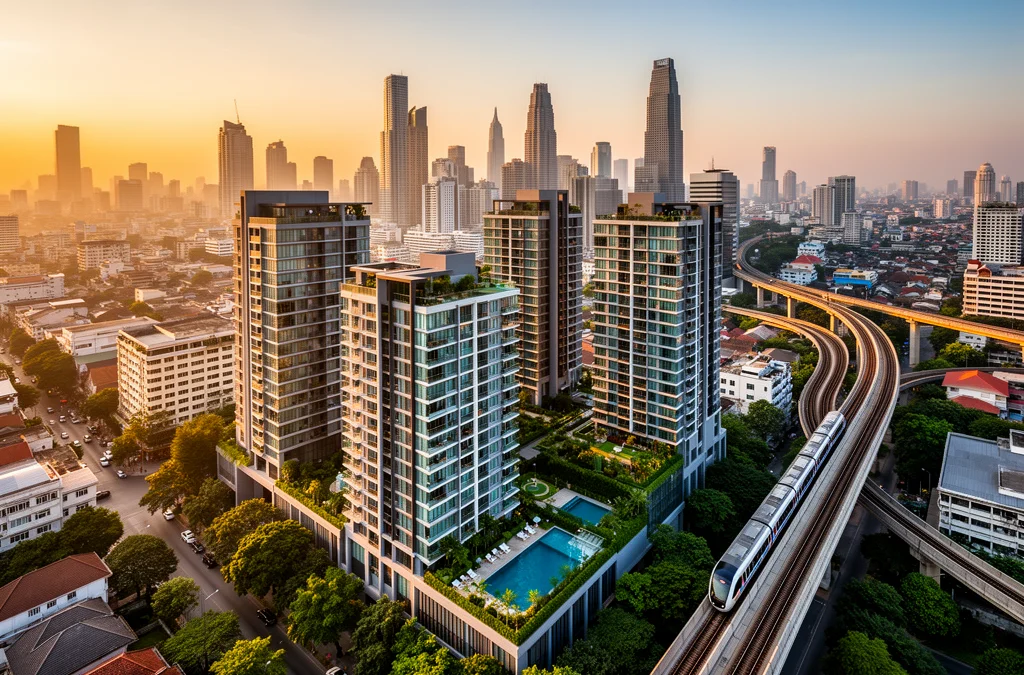
TL;DR: Bangkok offers over 90,000 rental apartments ranging from ฿8,000/month budget studios to ฿200,000+ luxury penthouses. The key to finding the right apartment is understanding neighborhood price tiers, transit proximity, and the full cost structure — which typically runs 15-25% above the listed rent. This guide covers everything from legal requirements to negotiation tactics based on current 2025-2026 market data.
When I worked as an urban planner at the Bangkok Metropolitan Administration (BMA), I spent years studying how the city's rapid transit expansion reshaped residential patterns. Today, the market for apartments for rent in Bangkok Thailand is larger and more diverse than ever — over 90,000 listings across 50 districts, with prices that range from ฿8,000 to ฿300,000 per month. Whether you are a first-time expat, a digital nomad, a corporate transferee, or a retiree planning a long stay, understanding how this market works will save you thousands of baht and months of frustration.
This guide draws on my professional experience with Bangkok's transportation infrastructure, zoning regulations, and development pipeline to give you an insider's perspective on renting in Thailand's capital.
Overview of the Bangkok Rental Market in 2025-2026
The Bangkok rental market in 2025 is characterized by oversupply in the condominium segment and steady demand in well-located apartments near mass transit. According to the Bank of Thailand's financial stability report, the residential property market has seen a structural shift since 2020, with rental inventory growing faster than tenant demand in most areas — giving renters more negotiating power than they have had in over a decade.
Key market figures for 2025:
- Total rental inventory: approximately 91,000 active listings across Bangkok
- Average rent for a 1-bedroom condo near BTS/MRT: ฿28,000–฿45,000/month
- Average rent for a studio farther from transit: ฿10,000–฿18,000/month
- Vacancy rate in central Bangkok: estimated 18-22% across completed projects
- New condominium supply pipeline (2025-2028): approximately 45,000 units
The oversupply situation means that landlords are increasingly willing to negotiate — both on monthly rent and on lease terms. I have seen tenants secure 10-15% reductions simply by signing longer leases (18-24 months instead of 12) or by offering to pay multiple months in advance.
How BTS/MRT Expansion Is Reshaping Rental Demand
During my time at the BMA, I worked on transportation-land use integration studies that tracked how transit corridors affect property values. The pattern is consistent: within 3 years of a new rail line opening, rental prices within 500 meters of stations increase by 25-37% on average.
The MRT Yellow Line (Lat Phrao–Samrong, opened 2024) and the upcoming MRT Pink Line (Khae Rai–Min Buri, expected 2026) and MRT Orange Line (Bang Khun Non–Min Buri, expected 2027) are creating entirely new rental zones that most guides written even two years ago do not cover.
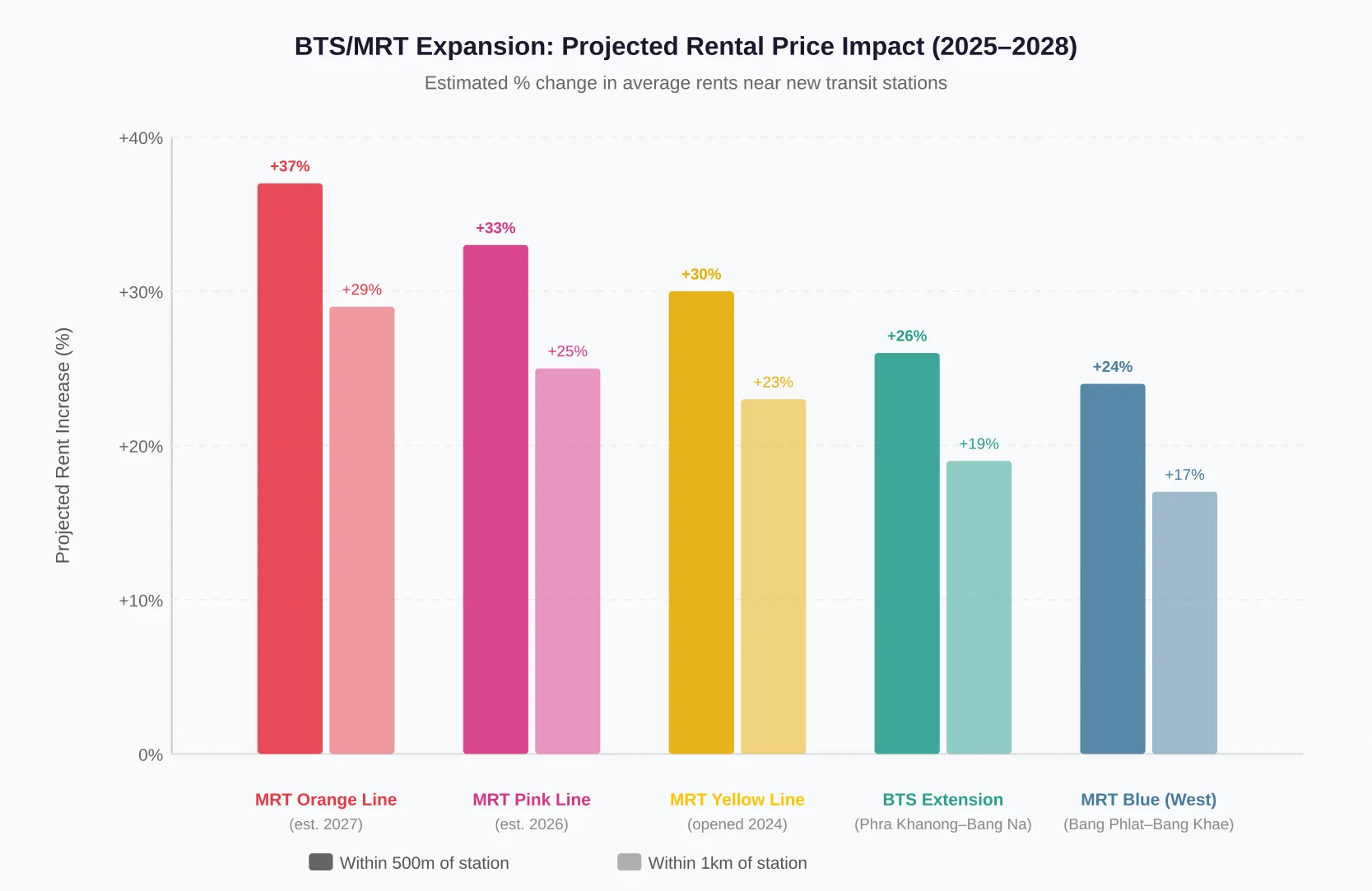
For renters willing to be early adopters, neighborhoods along these new lines — such as Lat Phrao, Bang Kapi, Samrong, and Min Buri — offer modern apartments at 40-60% less than comparable units on established BTS corridors like Sukhumvit. Finding apartments for rent in Bangkok Thailand along these emerging corridors requires looking beyond the usual English-language listing sites, but the savings are substantial.
Average Apartment Rental Prices by Bangkok Neighborhood
The single biggest factor affecting rent in Bangkok is proximity to a BTS or MRT station. A 1-bedroom condo within 500 meters of Thong Lor BTS station might rent for ฿55,000–฿75,000, while a similar unit 1.5 kilometers away drops to ฿25,000–฿35,000.
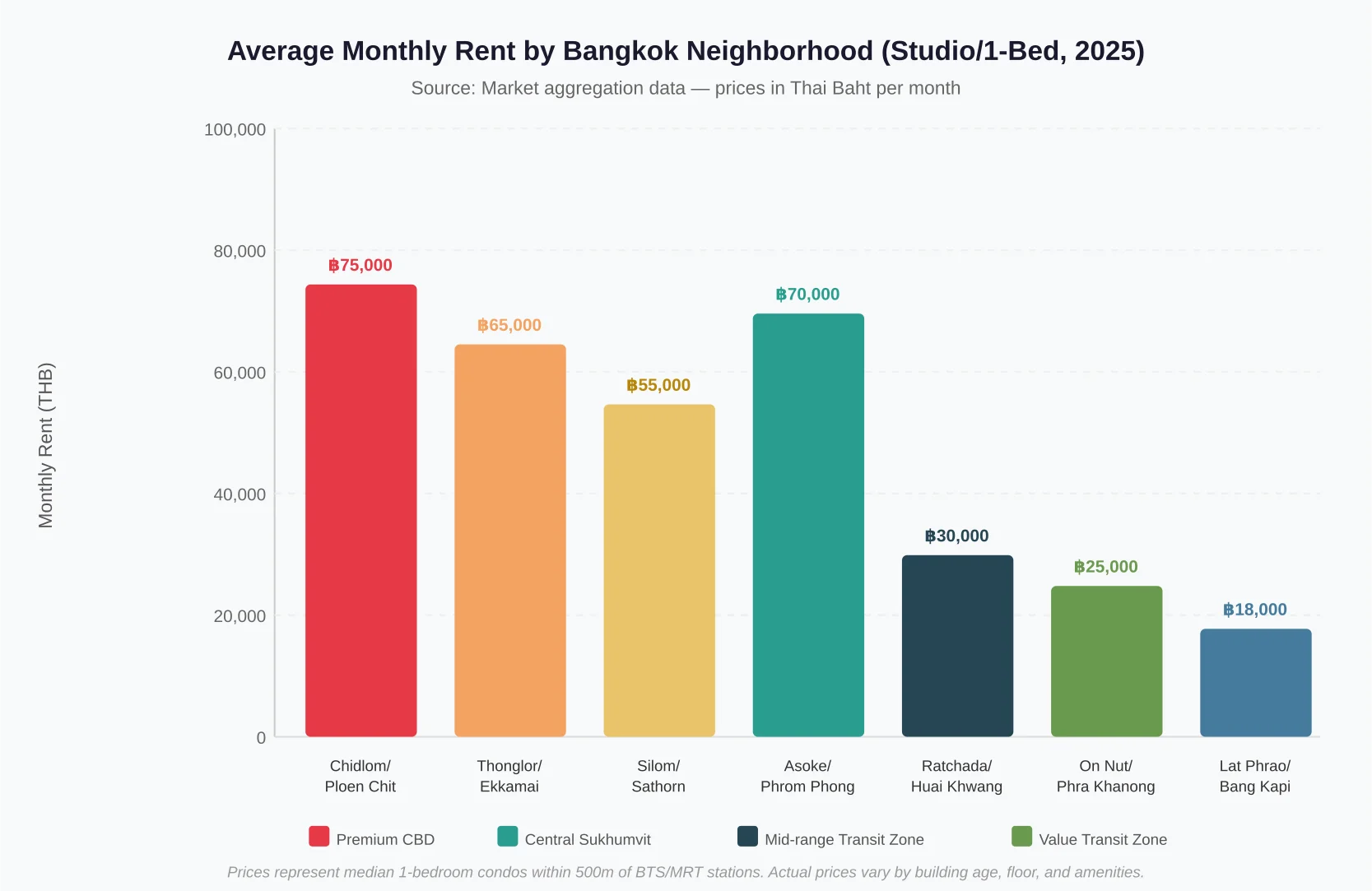
Here is a detailed neighborhood-by-neighborhood breakdown based on current market data.
Sukhumvit (Nana to On Nut)
Sukhumvit remains the most popular corridor for apartments for rent in Bangkok Thailand, particularly among foreign tenants. The BTS Green Line runs directly above Sukhumvit Road, and the neighborhood offers a concentration of international restaurants, coworking spaces, shopping malls, and nightlife. Browse Sukhumvit properties to explore current options.
| Sub-area | Studio (25-35 sqm) | 1-Bed (35-55 sqm) | 2-Bed (60-90 sqm) |
|---|---|---|---|
| Nana/Asok | ฿25,000–฿35,000 | ฿40,000–฿65,000 | ฿65,000–฿120,000 |
| Phrom Phong | ฿28,000–฿40,000 | ฿45,000–฿75,000 | ฿70,000–฿150,000 |
| Thong Lor/Ekkamai | ฿22,000–฿35,000 | ฿38,000–฿65,000 | ฿60,000–฿130,000 |
| On Nut/Phra Khanong | ฿12,000–฿20,000 | ฿18,000–฿30,000 | ฿28,000–฿50,000 |
What most people get wrong: They assume On Nut is "far" from central Bangkok. In reality, On Nut to Siam takes 15 minutes on the BTS. The tradeoff is a 40-50% rent reduction compared to Thong Lor, with only a 10-minute commute difference. As someone who mapped these commute times professionally, I can tell you that distance in Bangkok is measured in transit minutes, not kilometers.
Silom and Sathorn
Silom and Sathorn are Bangkok's traditional financial districts. These neighborhoods attract corporate tenants, embassy staff, and professionals working in the CBD.
| Sub-area | Studio (25-35 sqm) | 1-Bed (35-55 sqm) | 2-Bed (60-90 sqm) |
|---|---|---|---|
| Silom (near BTS) | ฿22,000–฿35,000 | ฿35,000–฿55,000 | ฿55,000–฿100,000 |
| Sathorn (near BTS/MRT) | ฿25,000–฿38,000 | ฿38,000–฿60,000 | ฿60,000–฿120,000 |
| Surawong/Rama IV | ฿18,000–฿28,000 | ฿28,000–฿45,000 | ฿45,000–฿80,000 |
Silom has fewer new condominium developments compared to Sukhumvit, which means the apartment stock tends to be older but often larger per baht. Several well-maintained buildings from the early 2000s offer 60-70 sqm 2-bedroom units for under ฿50,000 — a rarity in Sukhumvit. Browse Silom properties to explore current listings.
Ratchadamri, Chidlom, and Ploen Chit
This is Bangkok's premium residential zone, home to luxury malls like Central Chidlom and Central Embassy, as well as some of the city's most expensive condominiums. Expect to pay a premium of 30-50% over Sukhumvit for comparable units.
| Type | Price Range |
|---|---|
| Studio (30-40 sqm) | ฿30,000–฿50,000 |
| 1-Bed (45-65 sqm) | ฿50,000–฿90,000 |
| 2-Bed (75-120 sqm) | ฿80,000–฿200,000 |
These neighborhoods are ideal for executives and diplomats who prioritize walkability to Lumpini Park, embassies, and premium shopping. Most buildings here are full-service with 24-hour concierge, pools, and fitness centers.
Ratchadaphisek and Huai Khwang
The MRT Blue Line corridor through Ratchadaphisek and Huai Khwang has become one of the best value rental zones in Bangkok. With direct underground access to the CBD (5 stops to Sukhumvit/MRT interchange, 7 stops to Silom), these neighborhoods offer modern condominiums at significantly lower prices.
| Type | Price Range |
|---|---|
| Studio (25-35 sqm) | ฿10,000–฿18,000 |
| 1-Bed (35-50 sqm) | ฿15,000–฿30,000 |
| 2-Bed (55-80 sqm) | ฿25,000–฿45,000 |
Huai Khwang in particular has a growing Korean and Chinese expat community, with late-night dining and a more local atmosphere than Sukhumvit. The Thailand Cultural Centre MRT station area has seen several new condominium projects completed in 2023-2025, increasing supply and keeping prices competitive.
Thonburi (West Bangkok)
Across the Chao Phraya River, Thonburi districts like Bang Khae, Phasi Charoen, and Talat Phlu are emerging as budget-friendly alternatives with improving transit access. The BTS Silom Line extension to Bang Wa and the upcoming MRT Orange Line are driving interest.
| Type | Price Range |
|---|---|
| Studio (25-35 sqm) | ฿8,000–฿15,000 |
| 1-Bed (35-50 sqm) | ฿12,000–฿22,000 |
| 2-Bed (55-80 sqm) | ฿18,000–฿35,000 |
Insider tip from my BMA days: The area around Bang Wa BTS station is one of the best-kept secrets for budget-conscious renters. You get BTS access to Siam in 20 minutes, but rents are 60% lower than Saphan Taksin. Several new mid-range condominium projects have opened here in 2024-2025 with studios starting at ฿8,000-12,000/month.
Condos vs Apartments vs Serviced Apartments: Understanding the Difference
One of the most common sources of confusion for foreigners searching for apartments for rent in Bangkok Thailand is the distinction between three property types that are often used interchangeably in English-language listings. In Thailand, these are legally and practically distinct.
Condominiums (Condos)
Condominiums are individually owned units within a shared building. When you rent a condo, you are typically renting from a private owner through a property management company or agent. Key characteristics:
- Ownership: Individual unit owners (Thai or foreign)
- Lease terms: Usually 12 months, negotiable to 6-24 months
- Deposit: Standard is 2 months deposit + 1 month advance (total: 3 months upfront)
- Utilities: Often charged at commercial rates (฿5-8/unit electricity)
- Amenities: Pool, gym, garden typically included in rent
- Furnishing: Most come fully furnished with appliances
Condos represent approximately 75% of all foreign-targeted rental listings in Bangkok.
Apartment Buildings
In Thai real estate terminology, "apartment" (or "apartments") refers to a building owned by a single entity (usually a company) where all units are for rent. These are purpose-built rental buildings. Key characteristics:
- Ownership: Single building owner/management company
- Lease terms: More flexible — monthly, quarterly, or annual options
- Deposit: Often lower — 1 month deposit + 1 month advance
- Utilities: Usually charged at building rates (may be higher than government rates)
- Amenities: Full service — daily cleaning, laundry, 24-hour front desk
- Furnishing: Fully furnished, often with hotel-like services
Apartments are generally more expensive per square meter than condos but offer more services and flexibility.
Serviced Apartments
Serviced apartments are essentially hotel-style residences with full housekeeping, concierge, room service, and often restaurant dining on-site. They cater to corporate short-term stays and typically charge weekly or monthly rates.
- Lease terms: Flexible — daily, weekly, monthly
- Deposit: Often just 1 month or equivalent
- Utilities: Usually included in the rent
- Pricing: Premium of 30-100% over comparable condos
For most renters planning stays of 6 months or longer, condominiums offer the best value. For stays under 3 months, serviced apartments may be more practical.
Total Cost of Renting: Beyond the Monthly Rent
One critical piece of information that most rental guides overlook is the full cost structure. The advertised monthly rent is never your total monthly cost. Based on my analysis of typical expenses across different building types, you should budget an additional 15-25% on top of the listed rent when evaluating apartments for rent in Bangkok Thailand.
Electricity: The Hidden Cost
Electricity is the single most variable cost for renters in Bangkok. Thailand's climate means air conditioning runs 8-12 hours daily for most of the year, and the difference between government and commercial electricity rates adds up fast. The Energy Regulatory Commission (ERC) sets the base tariff, but building-level markups vary widely.
- Government rate: approximately ฿4.42 per unit (kWh) as of 2025
- Commercial/condo rate: ฿5.50–฿8.00 per unit (varies by building)
- Typical monthly consumption for a 35 sqm 1-bedroom: 500-900 kWh
- Monthly electricity cost range: ฿2,200–฿7,200 depending on rate and usage
Always ask the landlord or building management what electricity rate they charge before signing. This single question can save you ฿1,000-2,500 per month.
Water Charges
Water is relatively inexpensive but still worth checking:
- Government rate: approximately ฿12-18 per unit (cubic meter)
- Building rate: ฿18-30 per unit
- Typical monthly usage: 10-25 units
- Monthly cost: ฿180–฿750
Internet
High-speed fiber internet in Bangkok is affordable compared to most countries:
- 500 Mbps fiber: ฿500-600/month (AIS, True, 3BB)
- 1 Gbps fiber: ฿700-900/month
- 5G mobile (unlimited): ฿500-1,000/month
Many condominiums include a basic internet connection in the common area fee, but dedicated in-unit fiber is usually the tenant's responsibility.
Legal Requirements and Lease Contracts for Foreign Tenants
Thailand has a straightforward rental process for foreigners, but there are important legal and practical details to understand before you start browsing apartments for rent in Bangkok Thailand.
Documents Foreigners Need to Rent
The documentation requirements are minimal compared to many countries:
- Passport — valid for at least 6 months beyond the lease end date
- Visa — tourist visa is sufficient for most landlords; work permit holders may get preference
- Proof of employment or income — not always required but helpful for negotiating
- Bank statements — some landlords request 3 months of statements for higher-value properties
Foreign nationals can legally rent property in Thailand on any visa type, including tourist visas. There is no restriction based on nationality. The landlord handles the TM30 (tenant registration) filing with the local immigration office, which is required under Thai Immigration Bureau regulations.
Standard Thai Lease Terms
Most residential leases in Thailand follow a standard template governed by the Civil and Commercial Code:
- Duration: 12 months is standard; 6-month leases are possible but less common
- Deposit: 2 months' rent (refundable at lease end, subject to deductions)
- Advance payment: 1 month's rent (applied to first month)
- Total upfront: 3 months' rent equivalent (e.g., ฿90,000 for a ฿30,000/month unit)
- Rent payment: Due on the 1st of each month, usually by bank transfer
- Lease renewal: Typically at a 3-5% increase (or negotiable)
What to watch for in the contract:
- Ensure the contract is bilingual (Thai and English) — the Thai version is legally binding
- Verify the property owner's name matches the chanote (title deed)
- Confirm who pays for repairs and maintenance (standard: landlord for structural, tenant for minor)
- Check the early termination clause — standard is 1-2 months' notice with forfeiture of deposit
- Insist on a written inventory of furnishings and their condition at move-in
Deposit Protection
Thailand does not have a formal tenancy deposit protection scheme like some Western countries. Your deposit is held by the landlord, and disputes are resolved under the Civil and Commercial Code. This makes it essential to:
- Document the apartment's condition with photos and video at move-in
- Keep all receipts for any repairs or improvements you make
- Get the landlord's acknowledgment of the property's condition in writing
- Use a reputable agent who can mediate if issues arise at move-out
Best Neighborhoods for Different Renter Profiles
Not all Bangkok neighborhoods suit every lifestyle. Based on my urban planning work and years of studying the city's residential patterns, here are my recommendations for specific renter profiles.
Digital Nomads and Remote Workers
Top picks: Ari, Phra Khanong, Ekkamai, On Nut
These neighborhoods offer the best combination of affordability, transit access, coworking spaces, and café culture. Ari (BTS) has become Bangkok's creative hub with specialty coffee shops and co-working spaces. Phra Khanong and Ekkamai offer Sukhumvit-adjacent convenience at lower prices.
- Budget: ฿12,000–฿25,000/month for a modern 1-bedroom
- Key amenities needed: reliable fiber internet, quiet workspace, nearby cafés
- Transit: BTS access essential for networking and social events
Expat Families with Children
Top picks: Sukhumvit 39-63 (Prompong/Thonglor), Bang Na, Nichada Thani (Nonthaburi)
Families prioritize space, international schools, and safety. The Sukhumvit 39-63 area offers proximity to major international schools (NIST, Bangkok Prep, Wells). Bang Na provides larger units and gated communities at better prices. Nichada Thani near International School Bangkok (ISB) is ideal for families enrolled there.
- Budget: ฿40,000–฿120,000/month for 2-3 bedroom units
- Key amenities: pool, playground, proximity to schools, green space
- Transit: Less critical if the family has a car; school shuttle bus access matters more
Students and Budget Renters
Top picks: Huai Khwang, Lat Phrao, Bang Kapi, On Nut, Wang Thonglang
The MRT Yellow Line corridor and outer BTS stations offer the best value. Many buildings near universities (Ramkhamhaeng, Kasetsart) offer student-friendly pricing.
- Budget: ฿6,000–฿15,000/month for studios and small 1-bedrooms
- Key amenities: proximity to campus, affordable food options, laundry facilities
- Transit: MRT/BTS access or motorcycle taxi routes to campus
Corporate Executives and Diplomats
Top picks: Ploen Chit, Chidlom, Langsuan, Wireless Road, Sathorn
Premium locations near embassies, the CBD, and Lumpini Park. Full-service buildings with hotel-style amenities.
- Budget: ฿60,000–฿250,000/month for luxury 2-3 bedroom units
- Key amenities: concierge, pool, gym, parking, security, proximity to embassies
- Transit: BTS/MRT walking distance essential
Retirees Seeking Long-Term Stays
Top picks: Bang Na, Samut Prakan fringe, Rama III, Phasi Charoen, Bang Wa
Retirees on fixed incomes benefit from neighborhoods slightly outside the core, where rents are lower and the pace of life is more relaxed. Areas near hospitals (Bumrungrad, Bangkok Hospital, Siriraj) are also important considerations.
- Budget: ฿12,000–฿35,000/month for comfortable 1-2 bedroom units
- Key amenities: ground-floor access or elevator, nearby hospital, fresh markets, community
- Transit: BTS/MRT access for medical appointments and shopping
Step-by-Step Guide to Finding and Securing Your Apartment
1. Start Your Search Online
Begin by browsing property listings on our platform to understand current prices and availability in your target neighborhoods. Use filters for your budget range, number of bedrooms, and proximity to transit.
2. Shortlist 5-10 Properties
Narrow your list based on:
- Proximity to your workplace or school (check Google Maps transit directions)
- Building reviews on Google and social media
- Recent photos showing actual unit condition
- Whether utilities are included or extra
- Pet policy if applicable
3. Work with an Agent or Contact Landlords Directly
In Bangkok, rental agents are typically free for tenants — the landlord pays the agent's commission (usually 1 month's rent). This means you can use an agent's local knowledge at no cost. For direct landlord listings on platforms like Bangkok property projects, you may have more room to negotiate since there is no agent commission involved.
4. Visit Properties in Person
Never sign a lease without visiting the property. During your viewing, check:
- Water pressure: Run taps and shower simultaneously
- Air conditioning: Test all units — replacements cost ฿8,000-15,000
- Noise: Visit during different times of day; check for nearby construction
- Mobile signal: Test in the unit, especially bathrooms and bedrooms
- Security: Note CCTV coverage, guard presence, key card access
- Common areas: Check pool, gym, and garden maintenance
- Parking: Confirm availability if you have a vehicle
5. Negotiate the Deal
Bangkok's rental market in 2025 favors tenants due to oversupply. Negotiation strategies that work:
- Sign longer for a discount: Offer 18-24 months for 10-15% monthly reduction
- Pay quarterly instead of monthly: Some landlords offer 3-5% discount for quarterly advance
- Ask for included utilities: Negotiate 1-2 months of included electricity or internet
- Request furniture upgrades: If the unit is partially furnished, ask the landlord to add items
- Compare and negotiate: Get quotes from 2-3 similar buildings and use them as negotiating ammunition
6. Sign the Contract and Move In
Once terms are agreed:
- Review the bilingual contract carefully
- Verify landlord ownership (request to see the chanote/title deed)
- Pay deposit (2 months) and first month's rent via bank transfer
- Complete a detailed inventory with photos
- Register your address at the local immigration office (for stays over 90 days)
- Set up utilities in your name or confirm building-managed billing
Future Outlook: Where Bangkok Rentals Are Heading
Based on the BMA's transportation master plan and my analysis of current development patterns, here are the trends that will shape the market for apartments for rent in Bangkok Thailand over the next 3-5 years.
New Transit Lines Creating Value Zones
The Mass Rapid Transit Authority of Thailand (MRTA) has an ambitious expansion plan that will more than double Bangkok's rail network by 2032. The lines most relevant to renters in 2025-2028:
- MRT Orange Line (2027): East-west corridor from Bang Khun Non to Min Buri. Will open up affordable rental zones in eastern Bangkok.
- MRT Pink Line (2026): North-south corridor from Khae Rai to Min Buri. Connects Nonthaburi to eastern Bangkok.
- MRT Brown Line (proposed): Would connect the Phra Khanong area to the Bang Na area.
Rents within 500 meters of stations on these new lines are projected to increase by 25-37% within 3 years of opening, based on historical patterns from the MRT Blue and Purple Lines.
Condominium Supply Pipeline
According to the Real Estate Information Center (REIC), approximately 45,000 new condominium units are expected to be completed in Bangkok between 2025 and 2028. This oversupply will continue to favor renters in terms of pricing power, particularly in mid-range buildings (฿15,000-30,000/month category).
Areas to Watch
Based on my analysis of zoning changes and development applications:
- Bang Na–Samut Prakan corridor: The BTS extension and new Bang Na interchange are driving development. Expect rents to rise 20-30% by 2028.
- Rama III–Naradhiwas corridor: New commercial development and improved road access are making this area increasingly attractive for corporate renters.
- Phasi Charoen–Bang Wa: The MRT Blue Line western extension and BTS Silom Line terminus are creating a new secondary CBD. Rents remain low but are climbing.
For the most current listings and to explore available apartments for rent across all of Bangkok's neighborhoods, browse our updated inventory on the platform.
FAQ: Apartments For Rent In Bangkok Thailand
How much does it cost to rent an apartment in Bangkok?
Rental prices in Bangkok range from ฿8,000/month for a basic studio in outer districts like Lat Phrao or Bang Kapi, to ฿50,000-฿200,000/month for luxury condos in Chidlom, Ploen Chit, or Sukhumvit. The median 1-bedroom near a BTS/MRT station costs approximately ฿25,000-฿35,000/month. Factor in an additional 15-25% for utilities and building fees, bringing the real monthly cost to ฿29,000-฿44,000 for that median unit.
Can foreigners rent apartments in Bangkok?
Yes, foreigners can legally rent apartments in Bangkok on any visa type, including tourist visas. You need only a valid passport and the first payment (typically 2 months' deposit plus 1 month's rent, totaling 3 months upfront). Some landlords may request proof of income or employment, but this is not a legal requirement. There are no nationality-based restrictions on renting in Thailand.
What is the standard lease term for apartments in Bangkok?
The standard residential lease in Bangkok is 12 months, though 6-month and 18-24 month terms are also available. The typical upfront cost is 3 months' equivalent: 2 months' refundable deposit plus 1 month's rent in advance. For a ฿30,000/month apartment, expect to pay ฿90,000 before move-in. Serviced apartments offer more flexible terms including weekly or monthly arrangements, usually at 30-100% higher rates.
Which Bangkok neighborhoods are best for expat renters?
The top neighborhoods for expats are Sukhumvit (especially Thong Lor, Ekkamai, and Phrom Phong for amenities and transit access), Silom/Sathorn (for CBD proximity), and the Ratchadaphisek/Huai Khwang corridor (for value at ฿15,000-30,000/month). Digital nomads often prefer Ari and Phra Khanong for their café culture and coworking spaces, while families tend to choose Sukhumvit 39-63 or Bang Na for international school access.
Do Bangkok rental prices include utilities?
Most Bangkok rental listings show the base rent only — utilities are almost always extra. Electricity costs ฿4.42-8.00 per kWh depending on whether the building charges government or commercial rates, adding ฿2,000-5,000/month for typical usage in a 35 sqm unit. Water adds ฿200-600/month, and fiber internet costs ฿500-900/month. Always confirm the utility rate structure before signing, as commercial electricity rates can add ฿1,000-2,500/month versus government rates.
Data Visualizations

Urban Planning & Development Expert
Former urban planner at Bangkok Metropolitan Administration with expertise in transportation infrastructure, zoning regulations, and future development projects. Tracks BTS/MRT expansion and its impact on property values.
- Former Bangkok Metropolitan Administration Planner
- 15+ years urban planning experience
- Infrastructure Development Expert
- BTS/MRT Expansion Analyst